
Discworld Reread #8: Eric
A season in Hell (and other picturesque locales)

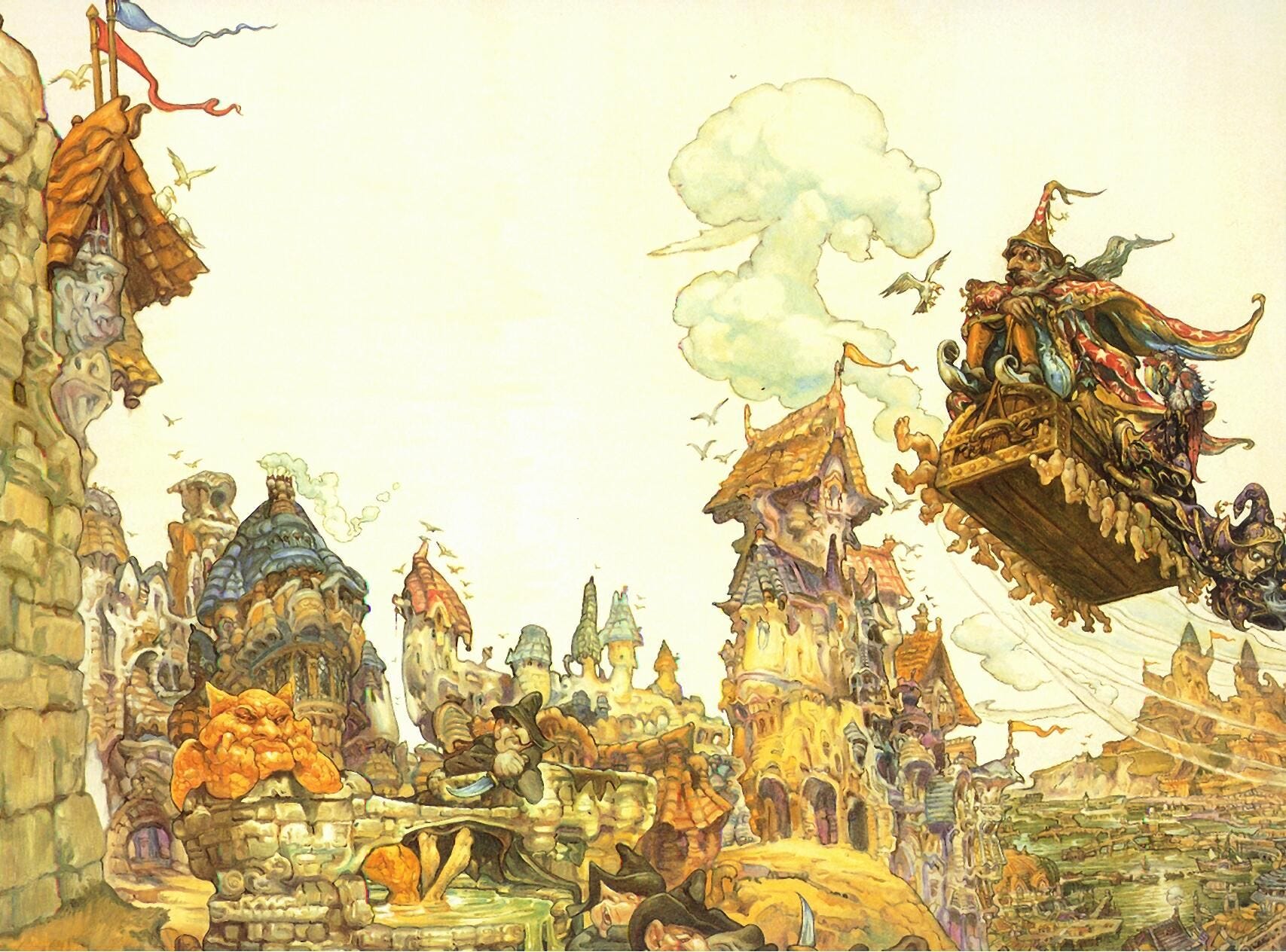
The last we saw Rincewind, he was being uncharacteristically heroic. In the confrontation with the sourcerer at the end of Sourcery (#5), it seemed as though he may have paid the ultimate price. But there’s life in those frightened bones yet! Having been accidentally sent to Hell, he’s accidentally rescued by a diminutive demonologist, who summons him back to the land of the living on the mistaken assumption that he, Rincewind, is a demon and can grant the wannabe warlock all his desires.
Except that … well, he’s Rincewind, Unseen University’s greatest failson, and however much he tries to explain this to the fledgling Faust, the reality doesn’t stick. Part of the problem—all of the problem, really—is that the callow conjurer is a fourteen-year-old boy named Eric with outsized dreams of power, wealth, immortality, and having the Disc’s hottest woman for a girlfriend.
And the fact that Rincewind is Rincewind should really have been the end of things, but there’s other diabolical designs at work. And so, with a surprised snap of Rincewind’s fingers …
1. Faustiness
Faust Eric (1990) is the ninth Discworld novel and, with the possible exception of The Last Hero (#27), the shortest. When I first read it, it felt a bit like a writing exercise dashed off between two more substantial Discworld instalments—a thought experiment along the lines of “what if Faust was a horny teenage boy?”1
Perhaps that’s where it originated; perhaps it comprises some boil-over from Good Omens, which was also published in 1990. The conceit of humans having the capacity for more imaginative depravity than demons is a common theme there; so too we see parallels between the Demon King Astfgl’s desire to modernize Hell along bureaucratic lines and Crowley’s frustration with the medieval mindset of his fellow demons. Indeed, some of the funniest moments in Faust Eric depict long-suffering demons attempting to adapt to Astfgl’s reforms and speak in HR-approved platitudes.
At any rate, that was my thought when I initially read it: riotously funny in parts, but less substantial than most other Discworld novels. A lark, some excess thoughts that Sir Terry slapped together into a story. On rereading, some of that sensibility remains, but I’m more impressed with just how much is going on in this slim little book. In setting out young Eric’s three wishes—ultimate power, immortality, and the aforementioned hot girlfriend (along with a crapload of gold, for walking-around money)—Sir Terry gives himself a handy tripartite narrative framework with which to explore the Disc in both space and time.2
To wit: having “summoned” Rincewind and ensnared him in his magic circle, Eric enumerates his wishes:
“Let’s see, now. Oh, yes. I command you—thee, I mean—to, ah, grant me three wishes. Yes. I want mastery of the kingdoms of the world, I want to meet the most beautiful woman who has ever lived, and I want to live forever.” He gave Rincewind an encouraging look.
“All that?” said Rincewind.
“Yes.”
“Oh. No problem,” said Rincewind sarcastically. “And then I get the rest of the day off, right?”
“And I want a chest full of gold. Just to be going on with.” (21)
The problem with magically-granted wishes, of course, is that they never end up yielding what the wisher had in mind—especially when expressed in such an open-ended manner. There’s always a catch.
Especially when the powers granting your wishes are actively malevolent and using your greed and lust for power (and just bog-standard lust) as part of their literally diabolical coup d’etat. As things fall out, both Eric and Rincewind have been noticed by rival powers in Hell. The aforementioned reformist King Astfgl3 has been watching our nebbish necromancer with great interest:
The problem with being evil, he’d been forced to admit, was that demons were not great innovatory thinking and really needed the spice of human ingenuity. And he’d really been looking forward to Eric Thursley, whose brand of super-intelligent gormlessness was a rare delight. Hell needed horribly bright, self-centred people like Eric. They were much better at being nasty than demons could ever manage. (32)
But while Astfgl seeks to cultivate talent for Hell, a cohort of demons disgruntled with his bureaucratic changes seek to oust him; the leader of the mutiny, Duke of Hell Vassenego, intervenes at the key moment when Eric performs his demon-summoning spell. Instead of a bona fide Mephistolic agent, Eric gets Rincewind—whom Vassenego imbues with the ability to magically transport himself and his owlish occultist through time and space on a wild wish chase that will distract the increasingly enraged Astfgl.
So, to return to those three wishes: mastery of the kingdoms of the world, most beautiful woman who ever lived, immortality. Plus, a crapload of gold, which technically seems like a fourth wish, but who’s counting?
Again, there’s always a catch. After all, what does “mastery of the kingdoms of the world” actually mean? How literally should that be understood? As it falls out, not that literally—Rincewind’s first finger snap takes them into outer space, from which they can see below them “harshly lit in the arid vacuum of space, Great A’Tuin the world turtle toiled under the weight of Creation. On his—or her, the matter had never really been resolved—carapace the four giant elephants strained to support the Disc itself” (40). The ability to see the entirety of creation all at once is … sort of a mastery? There is some argument between Rincewind and Eric about whether a contract is necessary, and Eric demands tribute be paid, which leads Rincewind to snap his fingers a second time …
… landing them deep in the lost jungle kingdom of the Tezuma, who immediately seem to venerate Eric and give him the heaps of gold he desires. Indeed, they seem to recognize him as the ruler of the world, much to his delight. But again—a catch. Because there’s this prophecy, and while Eric is to be venerated, he is also to be sacrificed to the god of the Tezuma, Quezovercoatl.4 Along with all of his companions. Fortunately, they are rescued by the Luggage,5 which always seems to be catching up to Rincewind at just the right moment. Or rather, they aren’t rescued, so much as the Luggage wreaks havoc and Rincewind and Eric manage to escape. Third finger snap!
… which takes them back in time as well as space to the infamous war between Ephebe and Tsort, which was precipitated when Tsort kidnapped Elenor, the most beautiful woman in all the Discworld, whose face launched a thousand ships and burned the topless towers of Tsort (or possibly Ephebe, Eric is unclear on his history). Anyway, I think you see where this is going … Elenor! The timeless beauty!
Eric is very excited.
But there’s always a catch. When they finally find Elenor, they discover that she isn’t … well, she isn’t quite as she was when her abduction started the war. In the intervening years of the very long siege, she has settled down and had quite a lot of children. When Rincewind identifies her to a confused Eric, the titular thaumaturge protests.
“Don’t be silly,” whispered Eric. “She looks like my mum. Elenor was much younger and was all—” His voice gave out and he made several wavy motions with his hand, indicative of the shape of a woman who would probably be unable to keep her balance. (97)
Finally, Rincewind’s fingers take them into the non-space just prior to Creation, where the meet a creator—not, as the mousy little man is careful to note, the creator. This, as it turns out, is Eric’s immortality: which he didn’t frame as immortality per se, but that he wants “to live forever.” Forever it is! From the first swirling stardust forming celestial bodies, to the first days of the Discworld, where they’re deposited on a vast and empty beach, with millions of years to kill before anyone interesting evolves.
I know I don’t normally go in for plot summary in these rereads, but I offer this synopsis by way of outlining the narrative scaffolding here. Running through all this is the conflict in Hell as the increasingly irate Astfgl tries to figure out what has gone wrong and goes chasing off through time and space after Rincewind and Eric. The novel is at once a parodic rehash of the Faust legend, while also allowing for a surprisingly expansive tour of Discworld history, legend, and geography.
2. A Brief Tour of Pratchettian Themes
Notably, each episode gets successively more nuanced. The encounter with the Tezumen, while hilarious—especially when Quezovercoatl, who as it turns out is only six inches tall, attempts to fix his mess and comes to an ignominious end when the Luggage tramples him—is a pretty paint-by-numbers Pratchettian romp.
The faux Trojan War episode is rather more textured, as it introduces a significant convention Sir Terry will revisit, most notably in Jingo (#21) and Monstrous Regiment (#31)—namely, warfare and the avoidance thereof. It’s actually a rather striking aspect of the Discworld novels that they never feature what might be described as large-scale set piece battles, which are otherwise a staple of the fantasy genre. To the best of my remembering, the siege and sack of Tsort as (obliquely) described in Faust Eric might be the only instance; otherwise, the tendency is for Sir Terry to avoid or avert actual armed combat at scale, either through the contrivances of Sam Vimes (as in the aforementioned novels) or through fortunate happenstance, as occurs in Pyramids and Small Gods (#13) (and possibly others I’m not currently recalling).
Like I said: the clash of armies is otherwise a central event in fantasy, especially fantasy that fancies itself as “epic.” Four out of the seven Narnia novels feature impressive battles; The Lord of the Rings gives us Helm’s Deep, the Siege of Minas Tirith, and the Battle of Pelennor Fields. From there, fantasy novels without at least one large-scale battle are really the exception to the rule.
But then, one of the key elements of Sir Terry’s fiction is the subversion and indeed rejection of the kind of Manichaean logic animating a critical mass of fantasy, a logic that tends to make armed conflict inevitable. There is no shortage of people in Discworld who desperately want war—they’re the ones Sam Vimes must outmanoeuvre in Jingo and Monstrous Regiment—but Sir Terry is always at pains to highlight the fact that these combat enthusiasts are unlikely to be the ones fighting, and/or have little concept of what warfare actually is like, a succinct exemplar of which is helpfully offered in Faust Eric:
Rincewind was dragged before the Ephebian leaders, who had set up a command post in the city’s main square so that they could oversee the storming of the central citadel, which loomed over the city on its vertiginous hill. They were not too close, however, because the defenders were dropping rocks.
They were discussing strategy when Rincewind arrived. The consensus seemed to be that if really large numbers of men were sent to storm the mountain, then enough might survive the rocks to take the citadel. This is essentially the basis of all military thinking. (88)
The true brains behind the Ephebian military operation turns out not to be one of the “impressively dressed chieftans,” but a man who looks somewhat less than soldierly: “He had the armour, which was tarnished, and he had the helmet, which looked as though its plume had been used as a paintbrush, but he was skinny and had all the military bearing of a weasel.” This is Lavaeolus, the Discworld version of Odysseus;6 what he embodies is less the latter’s wily tactical brilliance than a sort of pragmatism born of cowardice,7 a desire to get through the conflict as quickly as possible, using whatever means are at hand. In the company of resplendently dressed generals whose principal strategy is to hope they have more men than the enemy has rocks, Lavaeolus’s pragmatism passes for genius. The shabby Odysseus anticipates the wisdom of General Tacticus, whose autobiography is a resource for Sam Vimes; Vimes quotes one particular nugget of wisdom: “the general has this to say about ensuring against defeat when outnumbered, out–weaponed and outpositioned. It is... 'Don't Have a Battle'" (Jingo 254).
The penultimate sequence before Rincewind and Eric are obliged to go to Hell takes them back to the dawn of Creation—floating in pre-something nothingness, they encounter “A little rat-faced man” sitting cross-legged in the void with “a pencil behind one ear” (108) who gives Rincewind an egg and cress sandwich. After watching the cosmos spiral into being, Rincewind asks “Who are you?” To which the little man replies, “I makes things” (116). “You’re the Creator?” Rincewind says, gobsmacked.
The little man looked embarrassed. “Not the. Not the. Just a. I don’t contract for the big stuff, the stars, the gas giants, the pulsars and so on. I just specialise in what you might call the bespoke trade.” He gave them a look of defiant pride. “I do all my own trees, you know,” he confided. “Craftsmanship. Takes years to learn how to make a tree. Even the conifers.”8
As I’ve said elsewhere, one of the origin points for my conception of magical humanism was with the idle question of how so much contemporary fantasy articulates an emphatically secular worldview in spite of the fact that the genre is rooted in emphatically religious (specifically Christian) diegetic logic—Tolkien the devout Catholic and C.S. Lewis’s thickly-painted Christian allegory, to be sure, but also the medieval literature that comprises a critical mass of the genre’s DNA. Without delving into that here—something for a future post!—suffice to say Sir Terry is one of the key authors in investigating this seeming contradiction. He was an avowed atheist, as he made clear most memorably in a talk he gave with The Guardian in 2009:
My religion such as it is is that we are shaped by the universe to be its consciousness. We tell the universe what it is. In my religion the building of a telescope is the building of a cathedral. I have no truck whatsoever with Genesis. I was inoculated against the Christian or Judaic Christian religion by reading the whole of the Old testament in one go (well, apart from the “begats”) and I thought that if this is true, we are in the hands of a madman.9
If you’ve never watched that video (embedded in the footnote), I highly recommend it. It really resonates with me because Sir Terry articulates a thoughtful atheism of a sort distinct from the Richard Dawkins/Christopher Hitchens/Sam Harris variety,10 i.e. one that doesn’t dismiss religion and spirit, but attempts to understand the numinous while also rejecting the premise of Sky Daddy.
Of course, one of the sticking-points that surfaces in the Discworld novels is the occasional reference to a Creator, such as in Wyrd Sisters (#6) with the suggestion that the Discworld possibly came into being because “the Creator of the universe got bored with all the usual business of axial inclination, albedos and rotational velocities, and decided to have a little fun for once” (6). I’ve always been aware that my assertion of Sir Terry’s essentially atheistic fantasy bumps up against this reference to the idea that there is, in fact, a Prime Mover of All Things. Otherwise, all that is divine is predicated on mortals and their infinite capacity for belief; even Death exists as a function of mortality—though I can’t recall if it’s ever spelled out, the implication is that when everything in the universe has died, so too will Death cease to exist.
But in Faust Eric, the introduction of not a singular Creator but the suggestion of a plethora of small-c creators all responsible for their own specialties, working across numerous multiversal creations, complicates the picture. In some ways, Sir Terry faces the same question as physicists theorizing the Big Bang: what existed before? And, in the classic conundrum of metaphysics: why is there something instead of nothing? The question isn’t answered, but we go a long way here to a far more complex and multivalent understanding of the Theory of Life, the Universe, and Everything.
3. Josh Kirby and the Art of Discworld
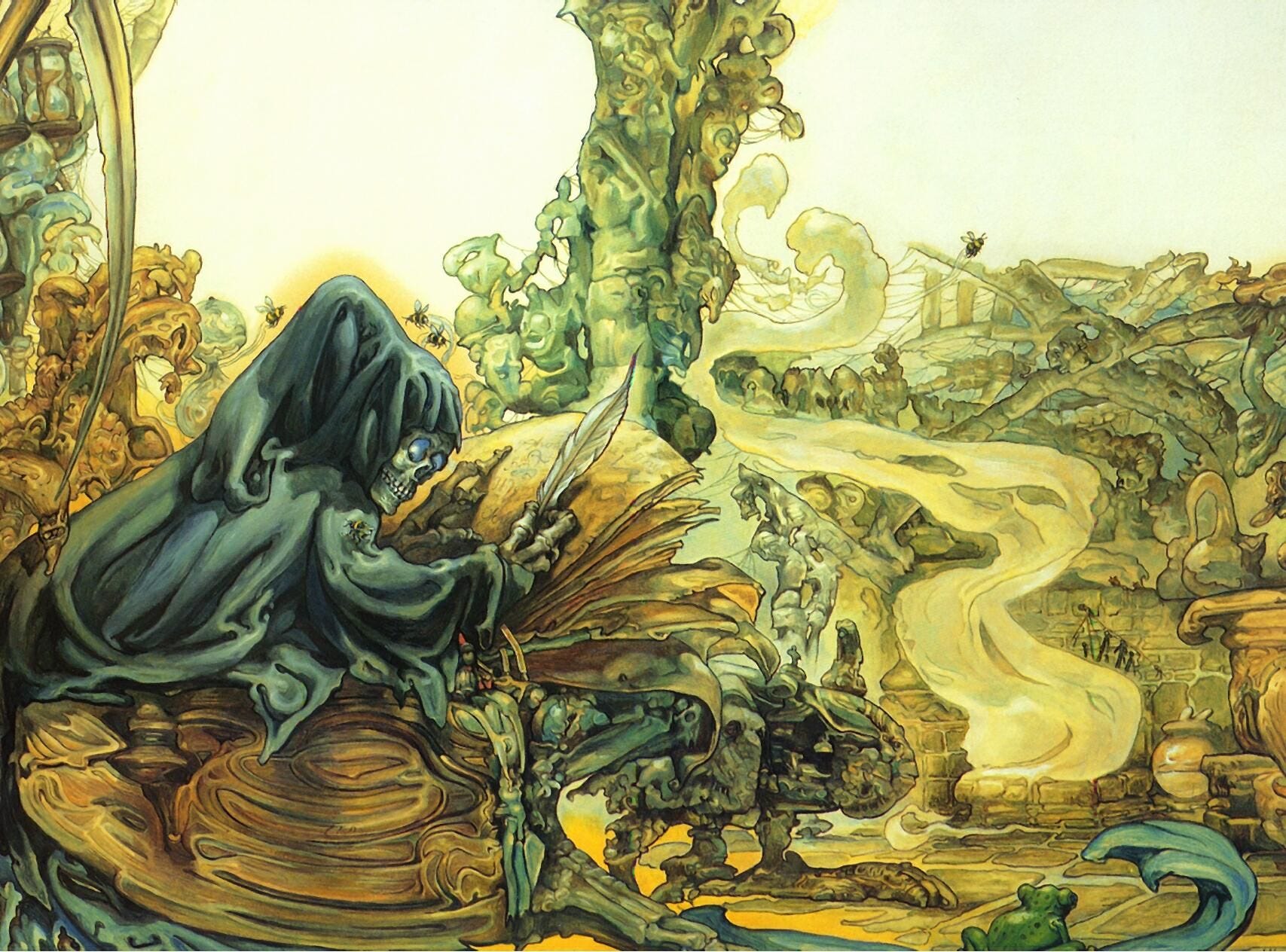
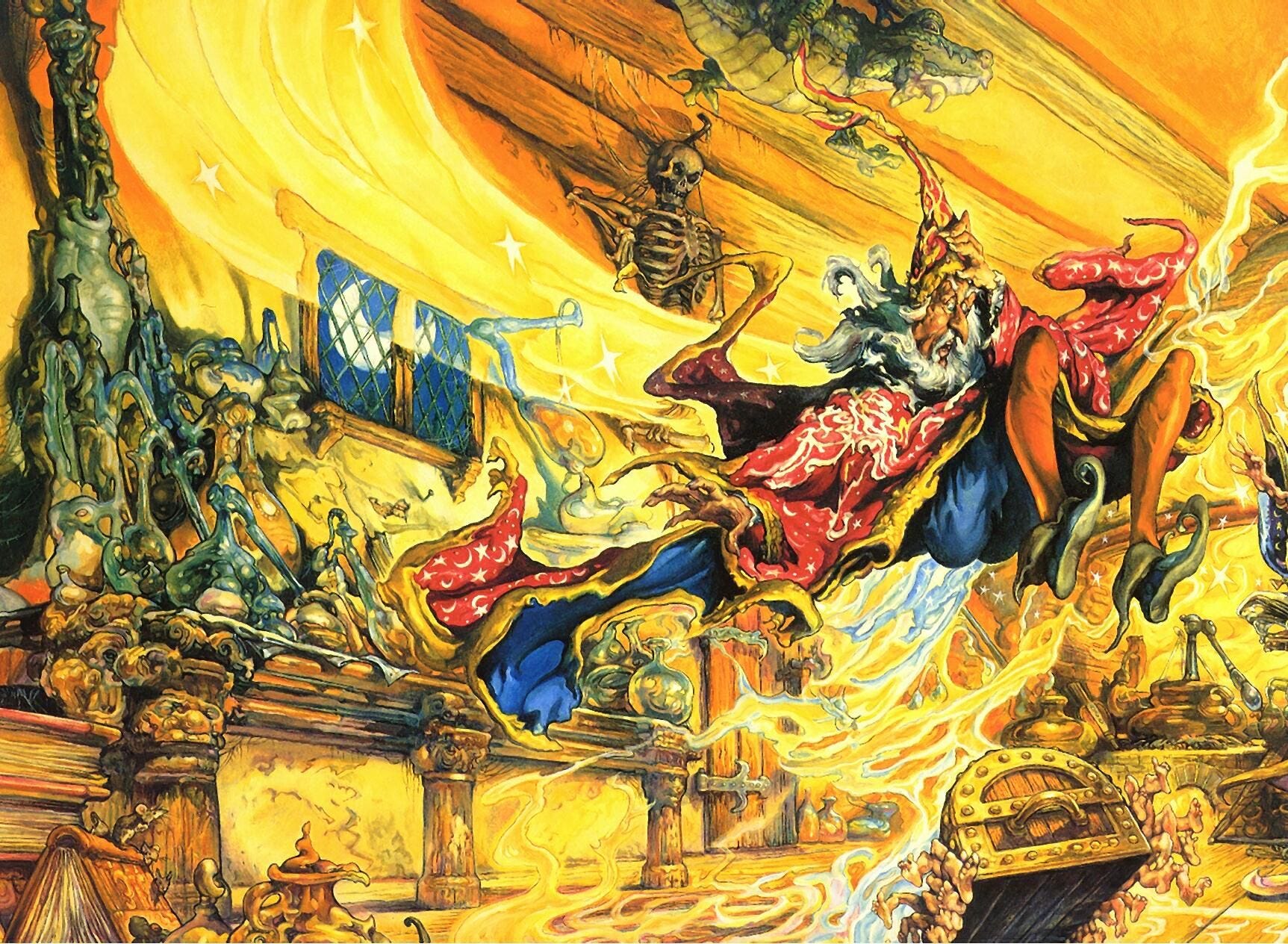
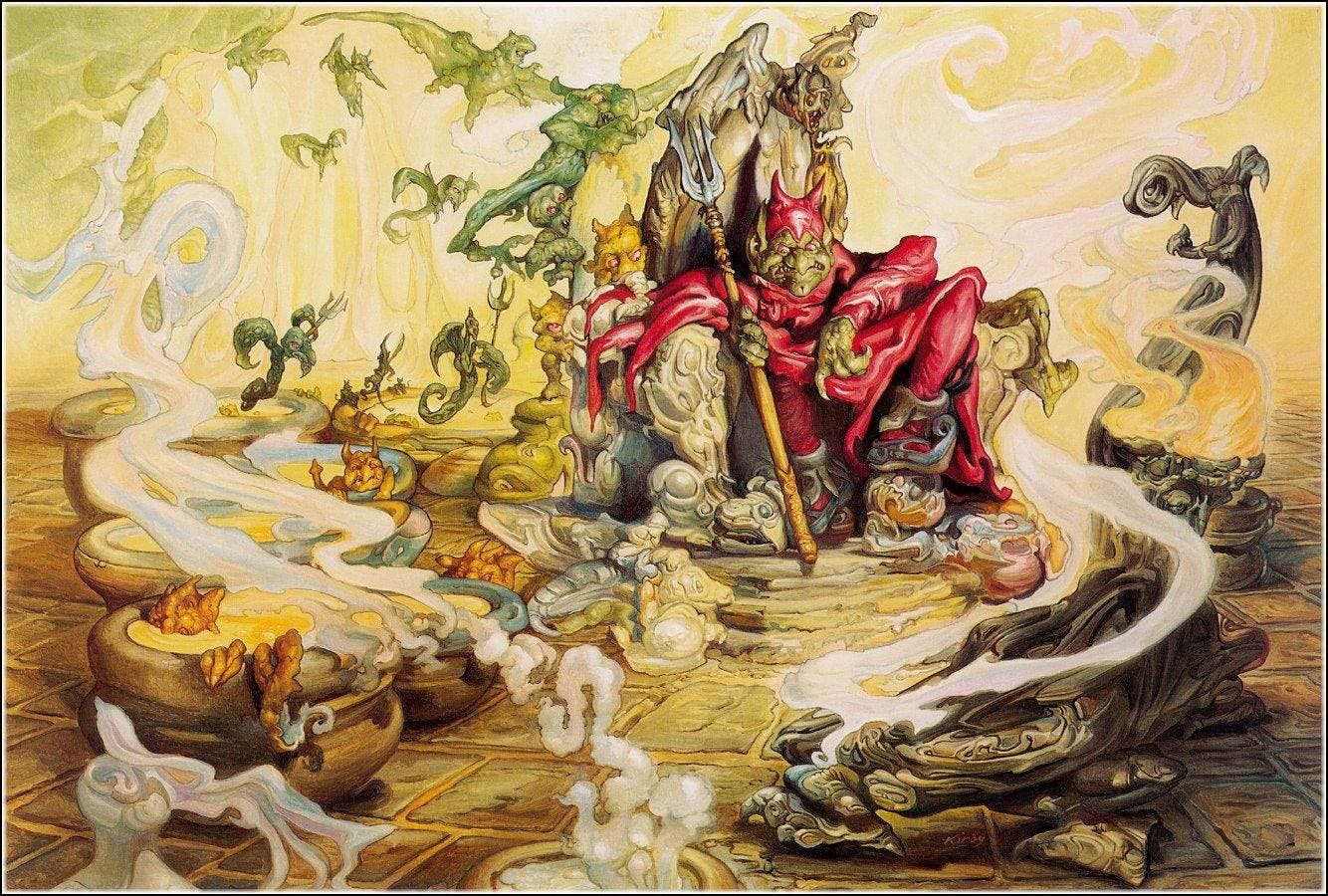
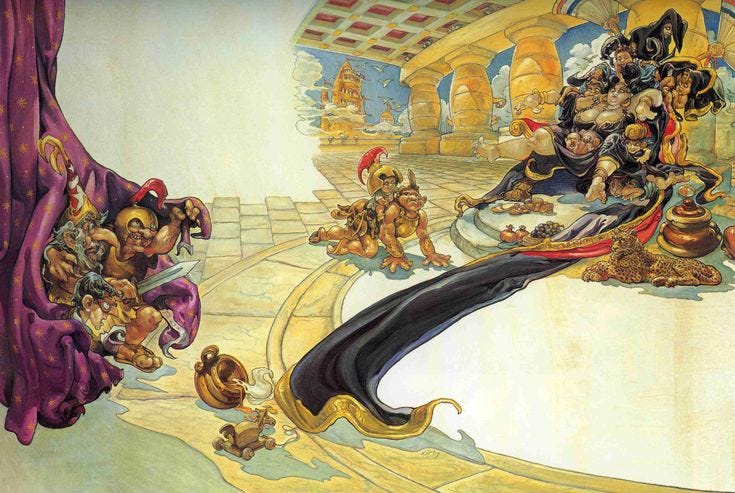
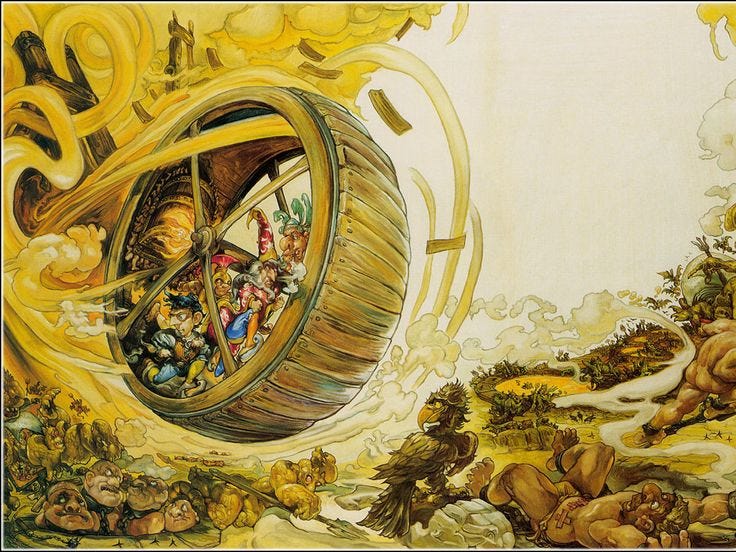
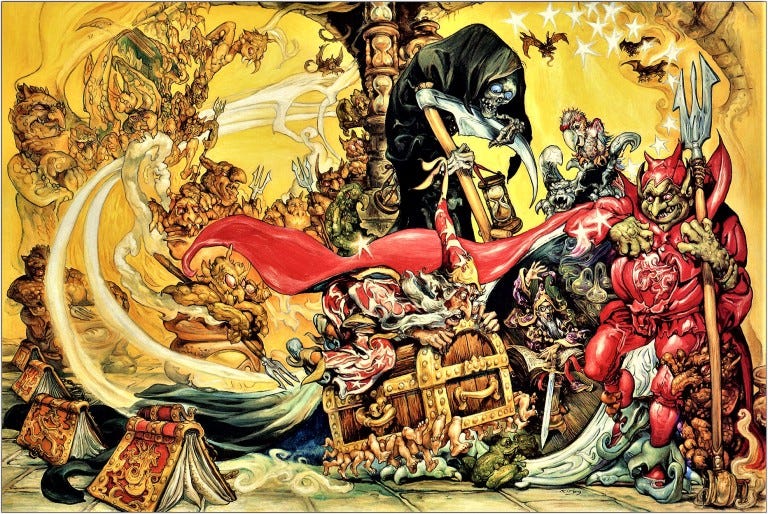
I’ve prefaced each of these rereads with the cover art for the novel in question. I haven’t said anything about the art of Discworld so far, but knew I’d be wanting to say something at some point. Given the slightness of Faust Eric, and the fact that it was also published as an illustrated edition, I figured that gave me an excuse to buy it and to devote some space here to the art of Josh Kirby, who illustrated the covers of the first twenty-six Discworld novels.
From The Colour of Magic (1983) until Kirby’s death in 2001, the Discworld novels featured his signature, now iconic, style—brightly coloured, crowded compositions jam-packed with characters and scenes from the novel in question. I will confess, once upon a time I found these covers somewhat off-putting; they seemed of a piece with the broader tendency of fantasy novels to be decorated with over-the-top, often lurid imagery that often had little to do with the actual content of the story. You know the type: excessively-muscled heroes and scantily clad femmes fatale or distressed damsels in kitschy neo-medieval panoramas that wouldn’t look out of place airbrushed on the side of a 1970s van. This was, I now grant, a failure of imagination on my part. I didn’t appreciate (a) the artistry of Kirby’s intricate compositions, and (b) the degree to which they took the piss of the aforementioned van-style fantasy art, just as much as Sir Terry’s stories took the piss of the fantasy they “depicted.” My loss: my misguided snobbery was one of two reasons I came to Discworld later in the game than I should have.11
REFERENCES
Gaiman, Neil and Terry Pratchett. Good Omens. Corgi, 1991.
Pratchett, Terry. The Illustrated Eric. Illustrated by Josh Kirby. Gollancz, 1990.
---. Jingo. Corgi, 1997.
---. Wyrd Sisters. Corgi, 1988.
NOTES
Spoiler: not that different from the standard-issue Faust.
To be perfectly honest, Rincewind has never been my favourite central character, but I’m coming to appreciate the way in which he functions as a means through which to explore the Discworld with a freedom and abandon (kicking and screaming though Rincewind might be dragged through these adventures) otherwise unavailable to the other character-based story clusters.
Demons, we learn from a footnote, are unfond of vowels.
The hilariously named Quezovercoatl turns out not to be a god at all, but a rogue demon who happens upon the peaceful Tezumen and inspires their high priest to unite their tribes under a new religion “dedicated to the proposition that all men should be taken to the top of ceremonial pyramids and be chopped up with stone knives” (61). Called on the carpet by Asftgl, he protests weakly that it was just a hobby, and besides which, isn’t that sort of death and destruction the sort of thing Hell was all about? Astfgl, in tearing a strip off the imp, offers some insight into his more modern theory of damnation:
“Thousands of more-or-less innocent people dying? Straight out of our hands,” he snapped his fingers, “just like that. Stright off to their happy hunting ground or whatever. That’s the trouble with you people. You don’t think of the Big Picture. I mean, look at the Tezumen. Gloomy, unimaginative, obsessive … by now they could have invented a whole bureaucracy and taxation system that could have turns the minds of the continent to slag. Instead of which, they’re just a bunch of second-rate axe-murderers. What a waste.”
This is one of the moments that most strongly echoes Good Omens, especially the scene when Crowley shares his diabolical deeds of the day with two of his fellow demons … who are profoundly unimpressed that he “tied up every portable telephone system in Central London for forty-five minutes at lunchtime” (28). When one of the other demons demands to know how, precisely, that secured souls for the devil, Crowley is at a loss to explain to these medieval thinkers how it was all about working at scale: “Thousands and thousands of souls all got a faint patina of tarnish, and you hardly had to lift a finger” (28-29).
In case you’re just picking up the story here and/or reading this post out of puzzled interest because it showed up in your feed, the Luggage is a magical travellers trunk constructed of sapient pearwood, which moves itself around on dozens of little legs that sprout beneath it. The Luggage is absolutely loyal to its owner, who happens to be Rincewind; it is also indestructible, obstreperous, and given to fits of ultraviolence when (a) Rincewind is threatened, or (b) it feels like it.
Like Odysseus, he conceives the plan to build a giant hollow horse. Unlike Odysseus, he doesn’t for a second imagine the enemy will be fooled by the ploy and instead has the Ephebian army sneak in through the back door while the Tsorteans sit around the horse waiting for the soldiers within to emerge. Unfortunately for Rincewind and Eric, Rincewind’s finger snap transports them into the horse, so they are the only ones to emerge, much to the Tsorteans’ consternation.
I didn’t mention it in my instalment on Pyramids, but when Djelibeybi disappears into an alternate space, it removes the geographical buffer between Ephebe and Tsort that has kept the nations from going to war again. Feeling the tug of inevitability, Ephebe and Tsort mobilize and set out to re-fight the legendary conflict in which Rincewind has dropped himself and Eric. The problem is, nobody is quite clear on who started the war way back then, nor which side built the notorious wooden horse, and certainly nobody remembers Lavaeolus’s back door gambit … which results in both sides building multiple wooden horses facing each other across the desert plain, with nobody quite certain what they should do with them. The sudden reappearance of Djelibeybi is a relief to both sides, who return home without ever joining battle.
“There was something vaguely familiar about his face, though,” we learn. “Rincewind thought it looked quite handsome” (88). Eric is the one to figure it out: “You know the funny thing about his name?” he asks. “Lavaeolus means ‘Rinser of winds” (105).
Reading this passage, I had two thoughts. One was that this was reminiscent of Slartibartfast’s pride in designing the award-winning Norwegian fjords in The Hitchhiker’s Guide to the Galaxy. The other was that a variation of this scene in the present moment would feature this diminutive creator ranting about how generative A.I. was ruining the work previously done creating the finer detail of matter across the multiverse.
.
I can’t remember who said it, but the best characterization I’ve heard of the “New Atheism” is that it seems a lot like the old atheism, except it involves being a dick. Considering how far to the irrational right that cohort has skewed in recent years, that observation takes on the patina of prescience.
The other reason? No maps!
Another fascinating post. I have no memory of reading this, which may be a memory lapse but more likely just that my eager but unsystematic reading of Discworld has left a couple of gaps.
Terry obviously isn’t the first to come up with the idea of multiple local creators—I immediately thought of Slartibartfast in The Hitchhiker’s Guide to the Galaxy.
It has been half a century or more since I read the detached story "Screwtape Proposes a Toast", but your aligning of _Good Omens_ and this work rings a bell; ISTR Screwtape discussing how modern demons worked on the gradual erosion/damnation of millions rather than the harvesting of a single high-quality soul, which makes me wonder whether Pratchett was familiar with that bit of C. S. Lewis.