
Some Thoughts on Pluribus
Or, if ChatGPT was seven billion people ...


When I first heard the premise for Pluribus, Vince Gilligan’s new series, I admit I was less than interested. I don’t know why, precisely—the idea of a worldwide utopian bliss that takes hold but for one curmudgeonly woman did not snare my interest, even if that woman was played by Rhea Seehorn. Then I heard it was really all about AI, and my interest ebbed even further.
But of course, I soon started hearing rave reviews, some from people whose opinions I value highly, and so when my wife got a free month of AppleTV,1 we decided to give it a go (after powering through the most recent season of Slow Horses, of course—priorities!).
Honestly, I should have given Vince Gilligan the benefit of the doubt.
Before I continue, I should warn that I’ll be discussing aspects of the first season of Pluribus in some detail, so …

Pluribus is precisely what it was advertised as, and yet entirely not what I expected. I don’t know what I expected, I admit; what sucked me into the show, and what keeps resonating in my mind, is the way in which the show imagines the utopian collective consciousness. The “joining” of every human on earth save twelve people functions as an approximation of how Artificial General Intelligence (AGI), as imagined by its would-be creators, might. To wit: everybody on earth shares everybody else’s thoughts and memories. Though Carol Sturka (Rhea Seehorn), our main character, remains resolutely and defiantly unjoined, the Joined, or “Others” (as she calls them) know a lot about her because her partner Helen was joined to the collective shortly before falling and cracking her skull. As a result of the joining, all members of the collective have access to the sum total of human knowledge and, further, can perform such sophisticated actions as flying airplanes or doing surgery. In other words, if someone somewhere knows something, everybody else knows it; similarly, the skill one person has is now held in common.
What’s more, the joining renders all its members incapable of violence or doing any sort of harm to any living thing. This detail is quite reminiscent of Joe Haldeman’s novel Forever Peace (1998), which envisions a form of future combat in which elite soldiers operate battle bots remotely by being connected mentally—they virtually inhabit the machines along with the rest of their squad, with whom they share a mind link, such that they can operate as one without the need for vocalizing orders or intention. All such soldiers are limited to two-week tours at a time, ostensibly to protect their mental health. But the main characters discover that the real reason is because anybody who has spent more than two weeks connected to other humans loses the capacity to do harm. Too much time inhabiting the minds of others, in other words, engenders a radical empathy that removes the instinct and ability for violence.
This much is implicit in the collective mind of the Joined in Pluribus: being so joined, they cannot do harm. They are perfectly capable of eating the flesh of animals already dead but won’t slaughter livestock; they’ll eat produce already on the shelves but won’t pluck an apple from the tree or tear a carrot from the soil. This of course raises the problem of how to feed the world, which results in some discomforting solutions, as I get into below.
1. The Dystopian Collective
The show’s title is an allusion to the traditional Latin motto of the U.S., e pluribus unum, “Out of many, one.” It can be found on the Great Seal of the United States.

The motto speaks to the nation’s origins in federalism, in which the thirteen original colonies became the first thirteen states, all of which entered into a national coalition but retained their individual constitutions and a certain amount of political autonomy under federal authority of a central government. Anybody even vaguely familiar with American history knows how much the tension between state and federal power has been a sticking-point since the founding. Considering the various crises of federalism, the biggest of which was the Civil War, “out of many, one” has occasionally seemed somewhat optimistic.
For a nation whose self-fashioning is so rooted in the mythos of rugged individualism, the unum of the motto has often taken on dystopian connotations: any hint of collective action or arguments for a collective good reliably gets tarred as socialism or communism. Such indeed, as Heather Cox Richardson outlines in her book How the South Won the Civil War (2020),2 was the basis for mid-19th century anti-abolition arguments—the premise that emancipation would entail pernicious collective action by newly-freed slaves that would threaten the individual agency of white people. As she frequently notes in Letters From an American, this logic has long been endemic in U.S. politics and culture, especially but not exclusively on the right. It grates on anybody who has read even an iota of Marx to have the most anodyne social assistance characterized as Marxist or communist, but then any sort of philosophical or theoretical accuracy in this regard is entirely beyond the point. The point, rather, is to gesture vaguely at anything reeking of collective action or benefit as a threat to the absolute individualism of the pluribus.
Hence we can see in Pluribus a somewhat cheeky piss-taking of the present moment, in which the most passionate crusaders for a variety of absolute freedoms—of expression, of commerce, from regulatory regimes—are the very same people seeking to algorithmically collectivize the world.
It’s worth taking a moment to place Pluribus in the context of other dystopian SF that has envisioned the conflict between a hive mind and a society of individuals. Perhaps the most obvious is Star Trek: The Next Generation’s introduction of the Borg, the alien collective bent on assimilating every technology and species it encounters. Though as the Borg appear in successive films and spin-offs and our understanding of them becomes more refined, their most basic presentation—first in episode 2.16, “Q Who?,” and then in the two-parter 3.26 and 4.01, “The Best of Both Worlds”—remains the most menacing, when they are at their most implacable and undifferentiated.3
The Borg are useful to consider because in their original, non-nuanced iteration, they comprise pure threat. They are solely devoted to conquering and assimilating anything and everything that grows and improves their collective. They are, in this respect, individualism’s nightmare, while also being individualism’s vindication, as their inevitable defeat is a function precisely of their incapacity for innovation.

“Q Who?” aired in 1989. It is hard, given that historical moment, not to read the Borg as a science-fictionalization of the Japanese, specifically the Japanese automaking industry. Though this particular American phobia has faded from the cultural consciousness, there existed a near-hysteria in the 80s as Japanese cars started taking over the American market and Japanese corporate practices were characterized as, effectively, a collectivized nightmare in which workers’ individuality was surrendered to the greater good of Toyota and Honda. The standard charge was that the Japanese stole American design and refined it but were incapable of their own innovation (a charge now commonly levelled at China).
In this respect, the Borg of Star Trek fell into the standard frame of the hive mind as something unutterably Other and alien—and indeed, such Others from the early days of the Cold War to the present have frequently been literal aliens. The two principal film adaptations of Invasion of the Body Snatchers (1956 and 1978) are the most obvious examples here and arguably share the most DNA with Pluribus. A favourite of mine however is Robert A. Heinlein’s 1951 novel The Puppet Masters, which is about as on the nose as you’re going to get: set in the near future,4 it features a world that has settled into an implacable balance of power between communist Russia and China on one hand and the American-led democratic world on the other. Our main characters, including the narrator Sam, all work for a hyper-secret U.S. government agency called “The Section.” It is hard-boiled Sam and his femme-fatale partner Mary who discover that a crashed spaceship is actually an invasion, of amoebic slug-like aliens that affix themselves to your back and hijack your nervous system so that you become an automaton. What’s more, all of the slug-aliens are part of a single collective consciousness.
Like many SF works of fiction and cinema that come out in the 1950s, the communism allegory is unmissable. Heinlein, however, never particularly enamoured of subtlety, takes the unmissable and hits you between the eyes with it. At one point Sam specifically muses about the similarity between communists and parasitic aliens:
I wondered why the [aliens] had not attacked Russia first; Stalinism seemed tailormade for them. On second thought, I wondered if they had. On third thought, I wondered what difference it would make; the people behind the curtain had had their minds enslaved and parasites riding them for generations. There might not be two kopeks difference between a commissar with a commissar without a slug. (205)
Interesting here is the close encounter (so to speak) of an allegory with its object: communists and their alien equivalents are literally conflated, as we do in fact later discover that the Soviet Union had been invaded first. The familiar allegory of the collectivized invaders so common to tales of conspiracy and paranoia in the 1950s collapses upon itself and renders the association of the collectivized “slugs” and their collective identity with communism unequivocal.
All of which is by way of saying that (a) Pluribus is treading well-trod ground, but (b) the series’ comic turn lies in subverting Carol’s instinctive revulsion with the hive mind, and by making the prospect of Joining not necessarily dystopian or unappealing.
Also: hive minds and collectives, like all such dark spectres, function as expressions of fear, embodying the bogeyman of a given historical moment. The pod people in the original Body Snatchers are an obvious allegory of communism, but also have a whiff of antipathy to 1950s suburban conformism; in the 1978 version, communism again, along with a heightened fear of domestic governmental conspiracy. For the past two decades or so, the ubiquitous hordes of zombie apocalypse represent a host of different paranoid ideations.5
The unfailingly cheerful, endlessly accommodating, omniscient and omnipresent Joined of Pluribus are in many ways the purest distillation of the A.I.-enhanced techno-surveillance reality in which we find ourselves.
2. Soylent Green is people! Which we find unpleasant! But necessary …
Early last year I wrote a post about what I called the Banality of Weird, specifically in reference to the fiction of China Miéville (you can read it here). What I love most about certain examples of Miéville’s short fiction is how he travesties the Lovecraftian convention of cosmic dread. TL;DR: in Lovecraft, human existence is a speck in the infinitude of a horror-ridden universe, and when we make contact with those unthinkable horrors (manifest in his fiction in such Old Gods as Cthulhu), “we shall either go mad from the revelation or flee from the deadly light into the peace and safety of a new dark age” (“The Call of Cthulhu” 139). In Miéville, the adaptation to cosmic horror is brisk—a week or two of dislocation, and then we’re posting our Cthulhu-sightings to Instagram and a whole pop-up industry around Old God Tourism becomes the new big thing.6
One way I read this tendency in Miéville is as a cheeky critique of late capitalism, which is Blob-like in its capacity to absorb anything in the name of consumerism and monetization. The two stories I use to illustrate this tendency, “Covehithe” and “Polynia,”7 were both initially published in the early days of social media, which is by way of saying that the great maw of content-farming and its concomitant facility for normalizing the unthinkable has only widened.
As I note in the previous section, the sort of hive-mind-assimilating-individuals narrative was well established before Pluribus, and its tropes and conventions well-worn. It goes without saying that individualism is good and collectivism is bad and the loss of oneself is a fate worse than death.
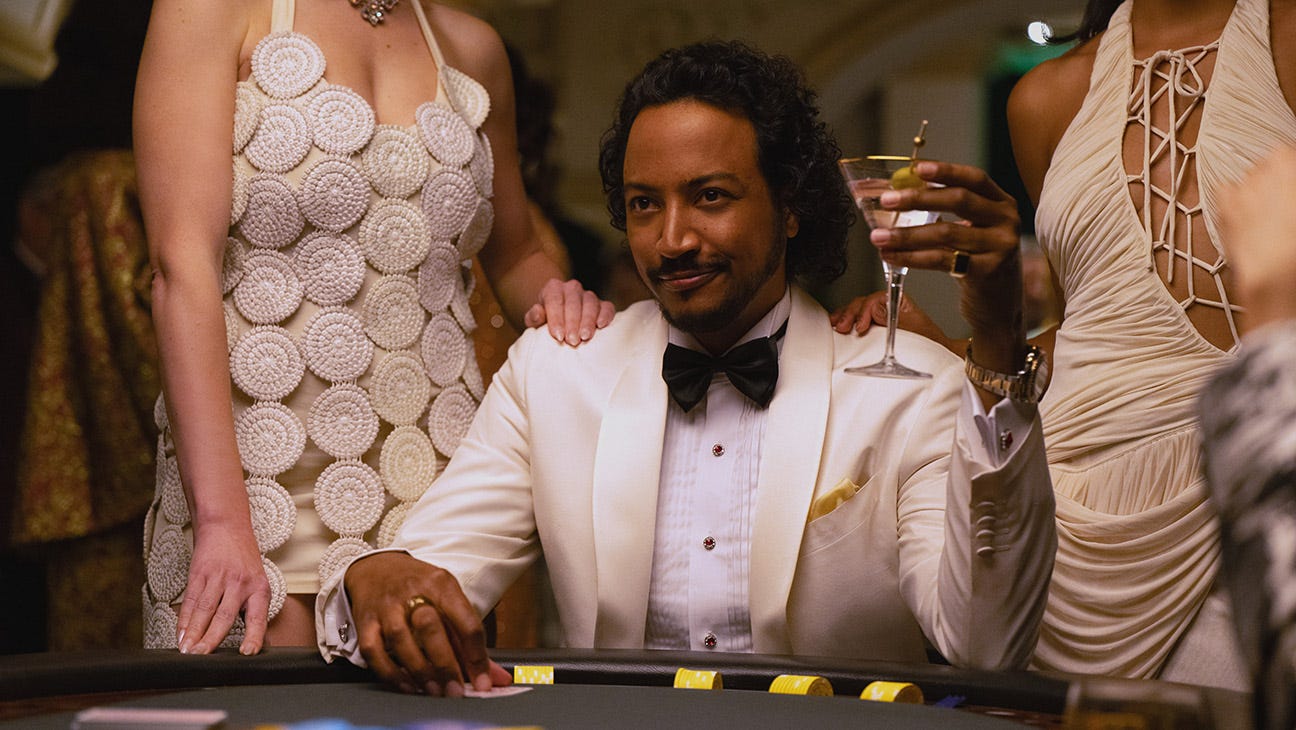
Carol Sturka, played with misanthropic relish by Rhea Seehorn, takes this premise as a given, and is baffled when her fellow Unjoined don’t seem to share her conviction that this development is pernicious, anti-human, and needs to be reversed. The others, indeed, seem amenable to the prospect of joining the apparently blissful collective, and at least one—Mr. Diabaté (Samba Schutte)—has decided to avail himself of the collective’s willingness to do anything for the Unjoined and is living his best hedonistic life in Las Vegas.
The subversive normalizing-the-unthinkable gesture in Miéville’s stories comprises a key aspect of Pluribus’s thematic armature. The endlessly friendly, cheerful, and accommodating character of the Joined initially presents as sinister; as it becomes increasingly sincere, there is the persistent sense (promulgated in part by Carol) of waiting for the other shoe to drop, which is continually frustrated by the collective’s continued candid, pleasant character.
The starkest example of this defeat of the sinister and conspiratorial by the collective’s sunny disposition occurs when Carol believes she has uncovered unequivocal proof of the Joined’s dark design. Investigating a former dairy factory that now manufactures a mysterious liquid consumed in great volume by the collective, she discovers frozen human remains and deduces that the collective are, in fact, consuming the dead.
(I can’t be the only viewer who, on seeing Carol’s discovery, did a bad Charlton Heston impersonation and cried out “Soylent Green is people!” Aside from Invasion of the Body Snatchers, Soylent Green (1973) here becomes the most obvious allusion Pluribus makes. The climactic revelation—that the manufacturers of the Soylent foodstuffs are, in the new “green” version of the product, feeding the dead to an oblivious populace—is a classic moment of paranoid/conspiracy cinema, right down to the fact that Charlton Heston’s iconic anguished cry goes unheeded as, dying from gunshots, he is taken away.)
Carol’s determination to reveal her own discovery is frustrated by the Joined’s candid admission that, yep, they’re eating the dead. Driving to Las Vegas to share the secret with Mr. Diabaté, she arrives only to discover he already knows. In what is one of the funniest sequences in the series, Diabaté plays the video the collective recorded for Carol, in which “the individual who was John Cena” breaks down the problem facing a world population that cannot slaughter livestock or even pluck fruit or vegetables: resources, they know, will soon grow scarce, and millions if not billions face starvation when that happens. They can consume anything already dead or picked, as well as fruit that falls from trees. But they can’t grow their own sustenance of either plant or animal varieties. Hence, they resort to reducing all consumable matter—including, regrettably, human corpses—to a nutritious elixir.

What is perhaps most hilarious about this sequence—besides the fact that it is delivered by John Cena—is its acknowledgement of the distastefulness of such cannibalism, however processed and unrecognizable. The sad-but-stoic tone expressed by the individual formerly known as John Cena strikes an adult pose in contrast to Carol’s fevered conspiracism. Where she misses the mark isn’t in uncovering the conspiracy, it’s in assuming it was at all conspiratorial. In his book The Geopolitical Aesthetic (1992), a study of conspiracy and paranoia in cinema, Fredric Jameson observes that conspiracy theory narratives are built on the narratively compelling paradox of two basic components: “a potentially infinite network, along with a plausible explanation of its invisibility” (9). Pluribus gives us the former but dispenses with the latter.
Which, I might add, is a somewhat discomforting development, as it arguably reflects a broader social and cultural trend of the twenty-first century, in which the large-scale adoption of surveillance and data mining as a blatant business model makes the traditional paranoia related to such panoptical behaviour seem positively quaint. Where once we nurtured dark fears of listening devices in our homes, now we place voice-activated data-gathering devices in our living rooms.8
In his book Empire of Conspiracy (2000), Timothy Melley argues that a great part of conspiracy’s appeal as a genre is that it allows us to imagine ourselves as individuals whose agency is threatened by a conspiratorial collective, as opposed to people whose individuality is always already under erasure:
One of [conspiracy’s] most important cultural functions, I shall suggest, is to sustain a form of individualism that seems increasingly challenged by postwar economic and social structures. Conspiracy theory, paranoia, and anxiety about human agency, in other words, are all part of a paradox in which a supposedly individualist culture conserves its individualism by continually imagining to be in imminent peril (6).
The most disturbing and uncanny aspect of Pluribus, I would argue, is the appeal of the utopian collective and the entirely rational manner in which it makes its pitch. It is, after all, a world in which war and conflict have been eradicated, in which a sort of gnostic communion with all humanity—the promise of innumerable religious and mystic visions—has been realized.9
3. Whither joined humanity? Or, the ChatGPT of it all.
I use the term “gnostic” deliberately, and almost certainly inaccurately (apologies to all my religious studies readers), to evoke the heady early days of the internet when the utopian potential of the digitally connected world was heralded by a host of techno-gurus. “Gnosticism” was used in its broadest sense to mean the melding of human consciousness, adopting the term from early Christian sects whose understanding of Paradise was as a blissful state of merged divine energy. Which is, to be clear, a very reductive understanding of historical Gnosticism, but which the new digital technologies of an interconnected world seemed to promise. “Techgnosis” was seen in some precincts as the next phase of human evolution.
Welp. I’d say we all know better now, except that doesn’t seem to be the case—at least not among the leading lights of the broligarchy, whose evangelism for the utopian future promised by A.I. is far more outsized than anything I remember from the halcyon days of Web 1.0.
I won’t devolve into another A.I. rant here, other than to stipulate that Pluribus is one of the smarter critiques. On its most superficial level, the collective sounds uncannily like ChatGPT in all its dialogue with Carol. More significantly, however, the Joining of humanity into a collective consciousness functions effectively as an LLM, something that becomes increasingly apparent episode by episode. To wit: the sum total of human knowledge and expertise has been dumped into the massive shared database of seven billion minds.10 It can communicate instantaneously and can access everything that was known by any one of its constituent parts (i.e. people).
BUT. A question soon arises: can the collective learn, or create? We know that they’re ultimately able to develop a modified version of the virus that will work on the Unjoined; one assumed there was enough scientific and medical expertise extant in the world at the time of the Joining to facilitate that. But beyond that?
I’m stepping into speculative territory here, so I’m burning with curiosity to see how and whether season two engages with any of these questions. It seems fairly clear to me however that the collective, like our extant LLMs, is structurally destined for stagnation. On one level, the collective inability to do harm is an appealing aspect of the Joined, a suggestion that (as I argue above) such shared consciousness necessarily entails a radical empathy.11 On another, the inability to do the basic work to sustain the world’s food sources can be read as a metaphor for the inability to innovate and create. More literally, Zosia’s undisguised excitement when Carol hints she might be writing again—and then pens the first chapter of her next romantasy novel—suggests a hunger for novelty. The Joined have already read literally everything; like the supercomputer they are, they hold all things that have been read, viewed, or thought by every single person all at once. But—they cannot themselves expand that.
Carol soon comes to believe Zosia’s encouragement to write more was just a stratagem to distract her from trying to find a means of reversing the Joining. Though Zosia more or less admits as much, I’m inclined to think both things are true: that even a cliché-ridden romantasy is like water in the desert when nothing new can be thought.
As I said, I’m dying to know how this plays out, and whether all my speculations—of which I’ve just shared a fraction here—will pan out, if at all. Vince Gilligan, frustratingly, has said he’s in no hurry to get to season two. This prompted Stephen King to tweet, essentially, that though he respects the creative process, he’s not getting any younger.

Amen to that.
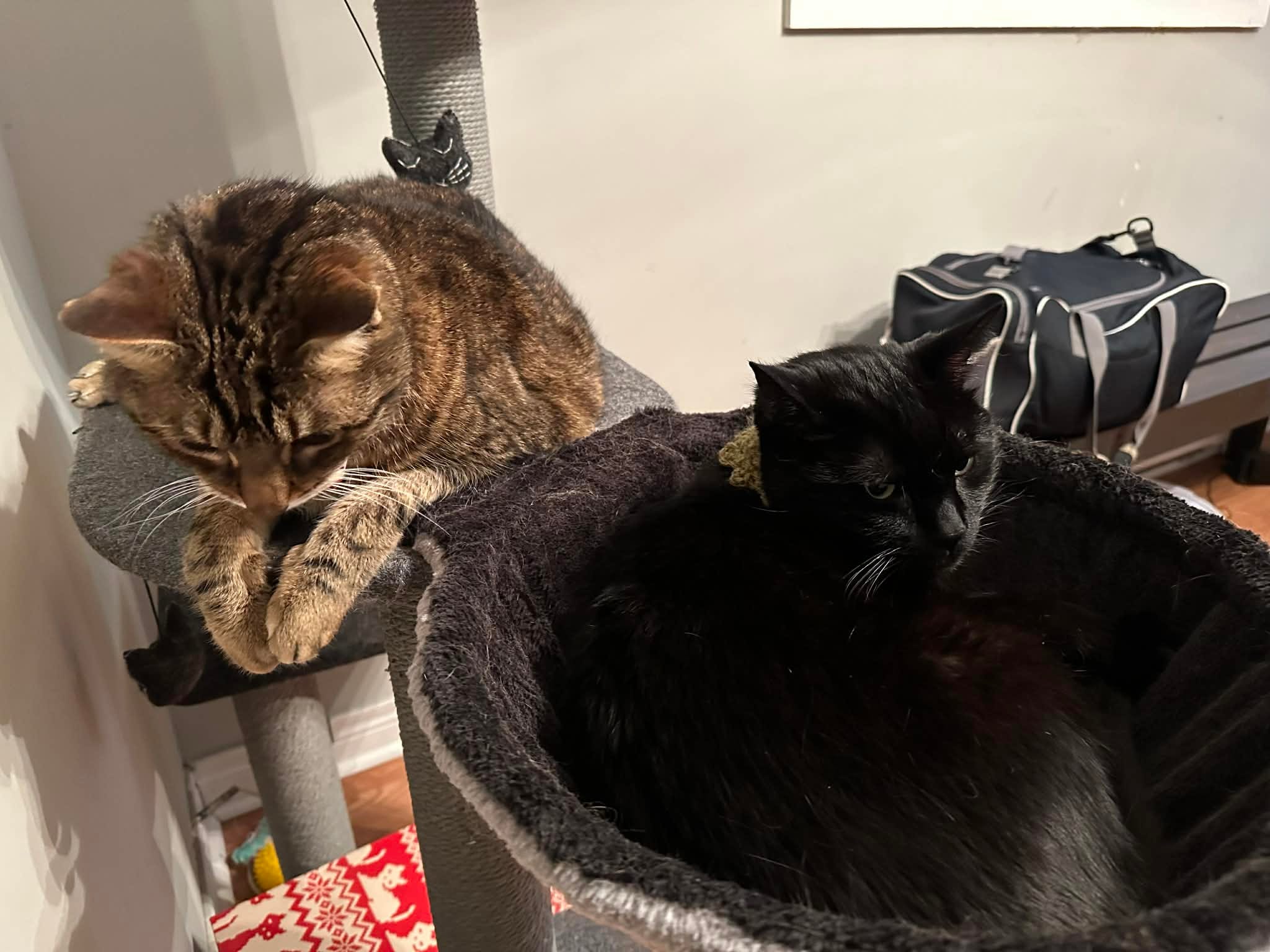
As promised, I will always now end posts with cats. Here is Bartleby in his favourite spot in the cat condo.

And here is Bartleby being sad because Gloucester slipped in when he wasn’t looking.
REFERENCES
Heinlein, Robert A. The Puppet Masters. Revised ed. Ballantine, 1990 (1951).
Jameson, Fredric. The Geopolitical Aesthetic: Cinema and Space in the World System. Indiana UP, 1992.
Lovecraft, H.P. The Call of Cthulhu and Other Weird Stories. Ed. S.T. Joshi. Penguin, 1999.
Melley, Timothy. Empire of Conspiracy: The Culture of Paranoia in Postwar America. Cornell UP, 2000.
NOTES
Several years ago, when we cut the cable cord, we also got rid of our landline, keeping only straight internet. With our smart TV, we had all the streaming services—Disney+, Crave, Prime, Netflix, and AppleTV—and even paying for all those, our monthly bill was a hundred dollars less than when we’d had the full cable package. Then all the streamers started jacking up their prices, so we’ve arrived at a point where we’re only going to pay for any two services at a time. AppleTV, Prime, and Netflix all got the chop. But it’s nice to have a month of Apple for the stuff we’ve missed.
Full title: How the South Won the Civil War: Oligarchy, Democracy, and the Continuing Fight for the Soul of America. Though the title suggests a straightforward account of the success of the Lost Cause narrative, Richardson’s argument is somewhat more nuanced and complex, teasing out the ways in which the Lost Cause itself is symptomatic of a broader American mythologizing that sought to pre-empt and fracture any working-class movement from finding common cause across racial and ethnic lines not just through the narrative of white supremacy but in framing such necessarily collective action as anti-individualist and thus anti-American.
I always find it interesting how depictions of hive minds, if they go on long enough, tend to introduce elements of individual personality. We see this already at work in “The Best of Both Worlds” with Jean-Luc Picard (Patrick Stewart)’s assimilation as “Locutus” under the premise that having him as a liaison will better facilitate the conquering and assimilation of humanity. Though Locutus is nominally just another Borg drone, the qualitative effect of having a central and beloved character so transformed necessarily gives focus and personality to what is supposed to be an undifferentiated node in the collective. This trend persists in the film Star Trek: First Contact (1996) with the introduction of the Borg Queen (Alice Krige), who becomes a recurring character in Star Trek: Voyager and Star Trek: Picard. Voyager of course also introduces Seven of Nine (Jeri Ryan) a former Borg drone, who returns in Star Trek: Picard, the first season of which continues to develop what I suppose we need to call Borg lore (not to be confused with Data’s twin).
2007—fifty-six years ahead of the novel, nineteen years ago by our reckoning. Yeesh.
Zombies don’t qualify as a hive mind per se, but they come close enough as to make no difference, considering that they tend to be huge undifferentiated hordes all joined by a singular purpose to assimilate living, thinking individuals into their ranks. Also, we have seen a similar tendency, the longer the genre has stuck around, to what I observed in an earlier footnote: more and more we see zombies or their analogues gaining measures of individuality and differentiation.
To be clear, these examples are my invention and not actually from stories Miéville wrote. He’s a far better writer than that. For a less tongue-in-cheek discussion of this dynamic, read the essay I wrote.
“Covehithe” is about sunken oil rigs reconstituting themselves on the ocean bed, coming to life, and emerging kaiju-like from the depths to walk ashore and lay eggs. “Polynia” is about giant icebergs suddenly materializing in the sky over London. In both stories, after a relatively short period of fear and confusion, people adapt to the new normal. In “Covehithe,” predicted rig landfalls have to be cordoned off by the authorities to prevent gawkers, and in “Polynia,” the floating icebergs become the targets of thrill-seekers who want to land on them for ice-climbing and recording their adventure.
Back when Facebook was first getting traction, I asked a friend of mine why he hadn’t joined and was treated to a strident lecture about how our parents’ generation had fought for civil rights and freedoms, and yet here we were willingly surrendering our privacy to corporations. When several weeks later I received a friend request from him and asked what had changed his mind, he sheepishly replied that he wasn’t getting invited to any parties.
In an odd way, a similar vision of a utopian collective appeared in the film Sinners (2025). As I wrote about back when it was released last year, the appeal made by the vampire Remmick (Jack O’Connell) and his growing band of undead was that, on being turned, they all shared consciousness and memory and all previous hatred and conflicts were erased. If I may be so gauche as to quote myself:
When the survivors inside the juke and the vampires without have reached their standoff—with the latter unable to touch the live humans absent an invitation—the vampires resort to persuasion. Join us, they say. We will grant you immortality and take away the pain of life. The vampires comprise a true collective, as they can share thoughts: Stack tells Smoke about Hogwood’s plan, which he knows because the first people Remmick turned were the young married couple, the husband of the pair being one of Hogwood’s Klansmen whose hood and robes we saw laid out. It’s true, the erstwhile Klansman admits. But he and his wife both profess now to have transcended the hate that animated their mortal lives. They, along with the others, promise community and love.
I then noted that, though this sort of appeal is not uncommon in comparable narratives, it lands differently in a film like Sinners, which is embedded in the historical context of the Jim Crow south, in which the kind of individual agency the twins Smoke and Stack (Michael B. Jordan) seek is made effectively impossible by the rigid racial laws and codes.
Give or take. I figure eight billion people, minus the 800M Zosia admits died in the process of the mass-joining of the world. That staggering “implementation cost” is consonant with the hand-waving Sam Altman et al do when asked about what happens should Artificial General Intellgence be realized.
One question that kept leaping to front of mind as I watched: was this alien-transmitted happiness virus a prelude to alien invasion? Something that makes the native population quiescent and unable to fight back? Or perhaps, given the vagaries of near-lightspeed travel, a slow-moving weapon that will exterminate a planet in the century or so it takes the invaders to arrive?