
Discworld Reread #7: Guards! Guards!
The first of the Watch novels

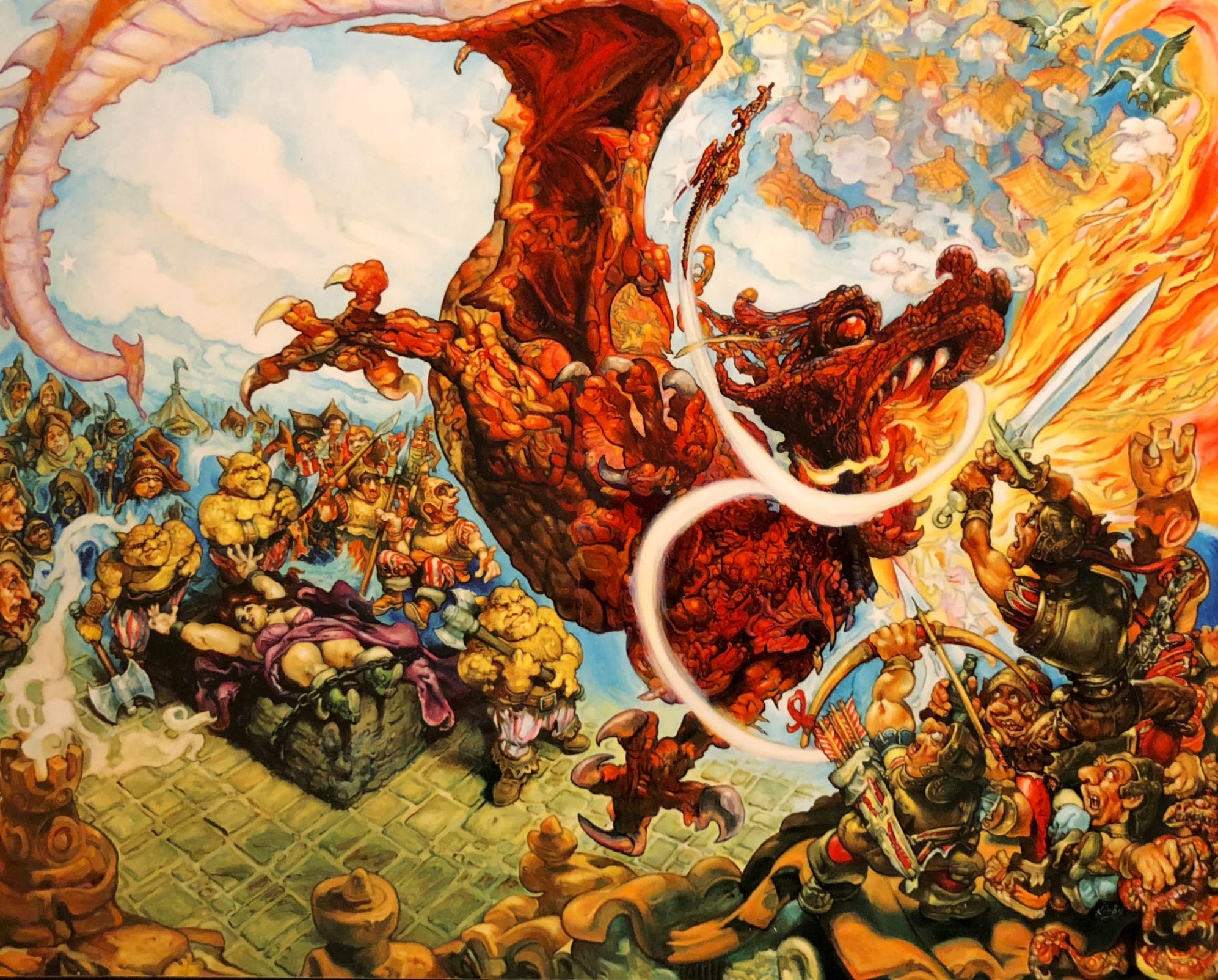
On an appropriately dark and stormy Ankh-Morpork night, a sinister group of black-robed brethren gather to summon a dragon, using a magical book filched from the University library. Meanwhile, elsewhere in the city the captain of the City Watch slumps in the gutter, dead drunk, despairing of what has become of his life … little knowing that his small band of watchmen will shortly be joined by an earnest new recruit whose idealistic naivety is matched only by his musculature. Meanwhile meanwhile, the city’s leader, Patrician Havelock Vetinari, reflects with mild satisfaction on how he’s managed to make an ungovernable city more or less functional. Meanwhile meanwhile meanwhile, unmarried noblewoman Sybil Ramkin tends to her collection of swamp dragons, little suspecting that an actual, huge dragon from the pages of myth and/or history will appear, and this event will throw her into the stunned arms of the aforementioned drunken watch captain.
<deep breath> Meanwhile meanwhile meanwhile meanwhile, the Librarian of Unseen University discovers something cataclysmic—a book is missing!
The black-robed brethren succeed in summoning a dragon, which they mean to use to terrorize the city and so discredit the Patrician; they will stage a confrontation between a Hero of their choice, who, upon vanquishing the dragon, they expect will be acclaimed as King and depose the hated Vetinari. Amazingly, their plan works! But as it turns out, dragons are not to be trifled with—and the beast the brethren summoned and then banished back to its alternate dimension finds its way back to Discworld. And this time, it will not be subject to the whims of the petty mind that originally yoked it …
1. A Lot of Moving Parts
Guards! Guards! (1989) is the eighth Discworld novel, and the first to introduce the main characters of The Watch—the Ankh-Morpork City Watch, that is, the police force that, at the outset of the novel, is little more than a joke to both the people of the city and its handful of ill-regarded coppers. By the end of Guards! Guards! it will have regained a great deal of status and regard, and from this point on will only grow in in terms of the size of its complement and its significance to the city.
Guards! Guards! is also, as far as I can tell, the longest Discworld novel so far. Not that any of the Discworld novels are particularly ponderous—in addition to the various other excesses of the fantasy genre Sir Terry avoids, he does not give us brick-sized tomes overflowing with exposition. His economy of storytelling is consistently admirable.1 Guards! Guards! might be the longest thus far, but my copy still clocks in at a manageable 426 pages of reasonably-sized font.
But if it’s the longest so far, that has a lot to do with that fact that there are a lot of moving parts to this story. This is at least partly to do with its setting. Even though every single one of the preceding seven novels features the city of Ankh-Morpork in some capacity, Guards! Guards! is the first instance in which we really start to get a sense of the city’s complex character—its domestic politics, its stratifications of class and wealth and status, its history both substantive and mythological, and the way it is at once atomized and diverse while also possessing a collective identity that asserts itself whenever a crowd is drawn to a spectacle.
There is a lot happening in this novel, so I’ll start here by enumerating some of its most salient aspects before diving down a couple of my usual thematic rabbit holes.
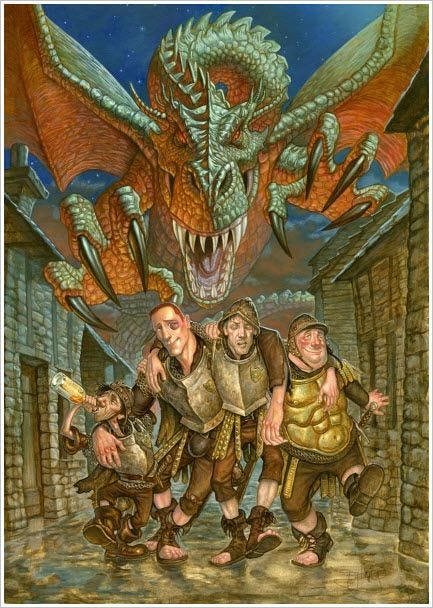
Samuel Vimes and The Watch. As I’ve mentioned in previous posts, many of Sir Terry’s most significant characters initially appear as cliché. We think of skeletal Death with his cowl and scythe, or Granny Weatherwax, whose forbidding witchy appearance would not be out of place on Halloween. Samuel Vimes is no exception: a crusty, hard-bitten and hard drinking cop whose world-weary cynicism doesn’t cancel out his innate belief in justice, nor does it prevent him from doggedly pursuing a case (even when his superiors order him off it or even fire him). Give him a rumpled raincoat instead of a breastplate and a revolver instead of a sword, and he would be entirely at home in any Hollywood police procedural.
And yet, like Sir Terry’s other such characters, his overdetermined aspects provide a basis from which to defamiliarize them—not least by dropping this eminently familiar character in the midst of a fantasy legendarium. Indeed, if Sam Vimes tends to hew closer to his cliché than Death or Granny, that works in part to defamiliarize the generic context of fantasy. The introduction of a noirish, hard-boiled dimension to these stories functions as a key part of Sir Terry’s broader project of critiquing fantasy specifically and genre more generally. And having the Watch as the vehicle for this critique is at once shrewd and hilarious, given that as a group the Watch is rather more a soft-boiled collective, a few shades lighter than noir.
As for the Watch themselves: as I commented above, we’ll see their complement grow a great deal over their eight-ish novels—grow in numbers, grow in diversity, and grow in their general regard and standing in Ankh-Morpork. But in Guards! Guards!, we get the core group: Captain Sam Vimes, corpulent Sergeant Fred Colon, larcenous and possibly inhuman Corporal Nobby Nobbs; to this trio we add eager new recruit Lance-Constable Carrot Ironfoundersson, an earnest six-foot six mass of muscle and idealism who identifies as a dwarf—because that’s how he was raised. And while Carrot’s ancestry is left mostly vague, it is strongly hinted that he is in fact the ancestral heir to the throne of Ankh-Morpork, a role to which he remains blithely uninterested.
Sybil Ramkin. There are two characters who are responsible for turning Vimes into the man who can lead a revitalized Watch. One is Vetinari, who comes to see the Watch’s potential; but his gimlet-eyed omniscience is a distant second to Lady Sybil Ramkin’s sheer force of personality in making-over Vimes. Lady Sybil is the last of the Ramkins, an extremely wealthy noble Ankh family. She is unmarried and spends her days tending to her menagerie of swamp dragons. Though this pursuit, which borders on obsession, is broadly perceived as daft—characteristic of the eccentricities of wealth—it quickly becomes clear that Lady Sybil is a force to be reckoned with, and her eccentricities mask a very clear-headed, determined intelligence. She is described in formidable terms:
Even shorn of her layers of protective clothing, Lady Sybil was still toweringly big. Vimes knew that the barbarian hublander folk had legends about great chain-mailed, armour-bra’d, carthorse riding maidens who swooped down on battlefields and carried off dead warriors on their cropper to a glorious and roistering afterlife, while singing in a pleasing mezzo-soprano. Lady Ramkin could have been one of them. She could have led them. She could have carried off a battalion. When she spoke, every word was like a hearty slap on the back and clanged with the aristocratic self-assurance of the totally well-bred. The vowel sounds alone would have cut teak. (128)
One of my favourite lines from all the Discworld novels comes when when a dragon-paranoid mob attempts to invade her property to kill her swamp dragons: “Lady Sybil’s bosom rose and fell like an empire” (183).
Once she sets her sights on Vimes, their ultimate partnership is effectively inevitable. Fortunately for Sam, he has the common sense to understand and appreciate Sybil, and he becomes a willing conquest. She thus becomes a presence in all the Watch novels to a greater or lesser extent; those novels in which her presence is greater, the novel tends to be the better for it.
Havelock Vetinari. We have of course already met the austere, preternaturally competent Patrician, though our first introduction in Sourcery was interrupted by his sudden and ignominious transformation into a small lizard. In Guards! Guards! we see him up close, as it were, for the first time:
You need a special kind of mind to rule a city like Ankh-Morpork, and Lord Vetinari had it. But then, he was a special kind of person.
He baffled and infuriated the lesser merchant princes, to the extent that they had long ago given up trying to assassinate him and now merely jockeyed for position amongst themselves. Anyway, any assassin who tried to attack the Patrician would be hard put to find enough flesh to insert the dagger.
While other lords dined on larks stuffed with peacocks’ tongues, Lord Vetinari considered that a glass of boiled water and half a slice of dry bread was an elegant sufficiency. (105-106)
Of all the characters in the Discworld novels, Vetinari has to my mind the most interesting and nuanced evolution—not least because he comes to be the crux of Sir Terry’s political philosophy as the novels go on. He begins as a stereotypically Machiavellian figure, becoming less stereotypical and more authentically Machiavellian as he evolves—less ruthless for the sake of ruthlessness, and more obviously preoccupied with the communal health of the polis.
At a certain point farther along in my rereading project I plan to devote a special essay to Vetinari and Sir Terry’s political philosophy as articulated by Discworld; I’ll have a few things to say about it in the third section of this post, but the gist of my Vetinari thoughts is that ultimately he is an idealized figure whose function is not unlike Adam Smith’s “invisible hand.” Which is to say: Sir Terry’s democratic and egalitarian impulses exist in tension with the conventions of fantasy. In imagining Ankh-Morpork—the embodiment in a variety of ways of his humanism—Sir Terry introduces Vetinari as a balancing element keeping the illiberal tendencies of the city in check (even as he himself is essentially illiberal in his machinations, but that’s part of the larger discussion to come in several months’ time).
Ankh-Morpork. Every single Discworld novel so far has featured scenes in Ankh-Morpork, but Guards! Guards! is the first to take place wholly in the city. It is also, as I noted above, the first novel in which the city has itself been a central character. Sir Terry’s polities are always worth paying attention to, whether it’s the affable peasantry of Lancre, the obstreperous philosophes of Ephebe, or the religiously observant masses of such nations as Omnia and Djelibeybi. In all cases, to greater or lesser extents, Sir Terry has a keen eye for how mass culture in different contexts manifests as an expression of a collective spirit; but Ankh-Morpork is the most productively complex of them all. It contains multitudes—literally. In a genre whose neo-medievalism unfortunately tends to misunderstand the Middle Ages as racially and ethnically homogenous, Ankh-Morpork is a chaotic celebration of a diverse, multicultural (and multi-species) city.
I haven’t yet had much to say about Discworld’s capacious, small-h humanism, which makes the term “human” a catch-all rather than specific and exclusive. That’s in part because it’s largely the Watch novels that explore this particular thematic thread. We see its first glimmers in the character of Carrot, a human who identifies as a dwarf because that’s how he was raised; though in Guards! Guards! he has a painful moment of recognition that he isn’t a dwarf, Sir Terry later abandons the distinction: in later novels it becomes established that, no, Carrot is a dwarf—all six foot six of him.
The Librarian and L-Space. I’ve spoken at length about the Librarian previously, He plays a key role in Guards! Guards!, given that it was a book stolen from the Library that made summoning the dragon possible, and the Librarian’s dogged determination to track it down that put Vimes onto the scent of the malefactors. What’s most notable however is that this is the first time we encounter L-Space, both as a concept and as, well, a space. In a footnote for my post on Sourcery, I promised and/or warned that I would be doing a special supplemental essay on the subject, delving into other fantasy libraries and especially talking about Jorge Luis Borges and his figuration of the library as labyrinth as world.
And I’ll be doing that in my next post after this one! So I’ll leave off talking more about L-Space here. Stay tuned.
2. Hic Sunt Dracones
In a legendarium as parodically capacious as that of Discworld, encounters with dragons are inevitable—and indeed, we encountered dragons right out of the gate in The Colour of Magic, with the dragon-riders of Wyrmburg. Dragons are fantasy creatures par excellence, combining magic, threat, guile, romance, all packaged in a sort of suave monstrosity—dragons terrify, but they do it with style.
They are also mostly impossible creatures. “Nothing in the world should have been able to fly like that,” Vimes marvels to himself as he watches the beast. “The wings thumped up and down with a noise like potted thunder, but the dragon moved as though it was idly sculling through the air” (206). For a lizard “the size of a barn with armour-plated hide, it was a pretty good trick.”
For how this trick is effected, Sir Terry provides the comic counterpoint of swamp dragons: dog-sized pathetic little things with stubby wings and a bad tendency to explode when they get indigestion. We encounter swamp dragons by way of Lady Sybil, who has made their breeding, care, and feeding her personal mission, with an extensive fireproofed kennel on her manor grounds. It is in attempting to learn something of dragons after the first few appearances of the big one (a “noble” dragon as Lady Sybil informs us, to be species-specific) that Vimes has his first encounter with his future wife; the sequence is at once one of the more hilarious meet cutes you’re likely to read, but also functions as a shrewdly comic critique of dragons in fantasy more generally. Swamp dragons are improbable creatures, but not necessarily impossible;2 they seem like creatures evolution might have missed for de-selection.
By contrast, giant flying lizards that can breathe fire defy a few key laws of physics and biology, though obviously in fantasy we tend to cheerfully wave those sorts of considerations away. Which is why Sir Terry’s dragons are so interesting. In the very first Discworld novel, the dragons of Wyrmburg aren’t “real” per se but are products of the imagination—within the magic-dense environs of Wyrmburg, if one can imagine dragons (sorry), dragons will appear. Similarly, the dragon summoned by the Elucidated Brethren feeds off magic: existing in an alternate reality where, presumably, such considerations as physics don’t matter, it requires magical objects to sustain it in the Discworld. When those objects are exhausted, back it goes. But when it manages to make its own way across realities, it taps into the almost limitless magic of Unseen University and, more importantly, its Library.
Vimes has this epiphany when he witnesses it return of its own volition. “Look at it,” he cries to Sybil. “It’s bloody impossible! It needs magic to keep it alive!” (232). The rash of thefts of magical objects, he realizes suddenly, had all been for the purpose of feeding the dragon. Trying to explain his meaning to Sybil, Vimes says,
“But supposing it needs magic like we need, like we need … sunlight? Or food.”
“It’s a thaumivore, you mean?”
“I just think it eats magic, that’s all,” said Vimes, who had not had a classical education. “I mean, all these little swamp dragons, always on the point of extinction, suppose one day back in prehistoric times some of them found out how to use magic?”
“There used to be a lot of natural magic around once,” said Lady Sybil thoughtfully.
This refiguration of dragon physicality and physiology is a shrewd workaround for what is otherwise a bit of a logical leap, even for fantasy. Discworld takes the premise that what technology is to SF, magic is to fantasy and plays with it in a host of different ways. Most notable is the recurring conceit of Roundworld technology replicated magically—such as cameras that function by having a tiny imp inside a box frenetically paint pictures, or magical phenomena and accidents that facilitate, variously, approximations of cinema (Moving Pictures [#10]), rock and roll (Soul Music [#16]), and railroads (Raising Steam [#40]).
One of the effects of this conceit, as with the magically-sustained dragon, is to draw the parallel between magic and technology—both in the sense of Arthur C. Clarke’s famous observation that a sufficiently advanced technology will seem like magic, but also that the novum3 at the heart of SF comprises its own form of magical thinking.
The resolution of the dragon crisis comprises another very Pratchettian inversion, starting with the transformation of a swamp dragon into something like a rocket-propelled lizard. When Vimes first meets Lady Sybil and her swamp dragons, she gifts him an unlikely specimen she’s named Goodboy Bindle Featherstone of Quirm—a bit of a disappointment as he cannot fly or flame and is, in her words, “a complete whittle.”4 She intuits however that he might make for a useful mascot for the Watch; upon his arrival at the Watch House, Nobby Nobbs promptly redubs him Errol, and the name sticks.
Errol spends most of the novel in apparent gastric distress, with parts of his gut in obvious movement while he consumes a wide range of eclectic objects, including two gallons of lamp oil, a tin of armour polish, and an iron kettle. Whenever the noble dragon appears, he becomes aggressive and agitated, like a shih tzu straining at his leash to attack a mastiff. Ultimately, however, his internal alchemy transfigures him into a stubby missile as he is finally able to flame in spectacular fashion … out of his butt. He streaks across the Ankh-Morpork sky to engage the dragon just as things appear hopeless for our heroes. But instead of fighting, it suddenly becomes apparent that Errol is … courting?
Realization dawns first, unsurprisingly, on Lady Sybil. “I really ought to have thought of it before,” she muses, “they’re always so much more territorial than the males” (391). Rather than fight to the death, Errol and his new mate fly off to what one assumes is the dragon equivalent of nuptial bliss, leaving the city battered and scarred but intact.
Somewhere in his prolific Lacanian ramblings on pop culture, the philosopher Slavoj Žižek rhapsodizes about the reveal in Shrek (2001) that the fearsome dragon is in fact female and just wants to be loved (finding her beloved in Donkey), praising the film’s ironic inversion of fairy tale tropes. That always comes to mind when I read Guards! Guards!, and I wonder if the writers of Shrek lifted the idea that blew Žižek’s mind from Discworld.
3. The Worst Form of Government
As I mentioned above, at a later point in this series I will write a supplemental essay focused specifically on Lord Vetinari and, by extension, Sir Terry’s political philosophy as it is articulated by the Patrician and his governance of Ankh-Morpork.5 For now, I’ll limit myself to noting a recurring theme running through Discworld: the tension between the monarchical imperative of fantasy and Sir Terry’s own stubborn egalitarianism.
Fantasy as a genre is partly rooted in nostalgia for a premodern sensibility. Both J.R.R. Tolkien and C.S. Lewis were animated by anti-modern animus, and worked in both their creative and academic (and, for Lewis, theological) spheres not for a return to the Middle Ages, but the recuperation of medieval mindsets and worldviews as antidote to what they saw as modernity’s spiritual aridity.6 As I’ve discussed at some length previously, a lion’s share of fantasy written in imitation of Tolkien repeats his principal tropes and conventions without the same degree of intellectual depth and complexity—one effect of which is the uncritical centring of monarchy as the default system of governance, often in conjunction with the trope of the “chosen one” á là the once and future king of Arthurian pedigree.
I probably don’t need to expound on why nostalgia for monarchical governance is regressive, any more than I need to point to the ubiquity of popular expressions of such nostalgia—from obsessive royal-watching to the simple fact of fantasy’s popularity to the economic juggernaut that is Disney’s princess-industrial complex.7 The appeal is obvious: the fantasy of the benevolent monarch literally born into that role who, absent bureaucratic impediments, gets shit done in a thoughtful but timely manner. Fold in the conceit that their fitness to rule is obvious from the fact that they are chosen by either divine or fateful forces, and it’s hard to deny the appeal that scenario has even when democracy seems to be mostly working. In the present moment, when so much seems irrevocably broken, it is unsurprising that cranks like Curtis Yarvin will have the ears of a billionaire class, who see themselves in monarchical terms as society’s natural rulers. Or indeed that there would be a critical mass of people who see them in the same light.
(But that’s a rant for a future post. And at least one previous one.)
All of which is by way of saying that one of Sir Terry’s principal insights—indeed, I would argue, one of his primary predicates—is that any democratically organized society will at best only ever be mostly working. And there will always be those who chafe at the mostly and whose utopian thinking stretches precisely as far as the conviction that if only they were in charge, everything would work perfectly. (We might term this mode of thinking the “I alone can fix it” fallacy.) It is perhaps a bit of an understatement to say that a significant dimension of Sir Terry’s philosophy is a profound scepticism about any such claim—a suggestion I can confidently make because this is an argument emerging from a critical mass of Discworld novels. Guards! Guards! is the first instance in which we see a sustained consideration of the principle most famously articulated by Winston Churchill, that democracy is the worst form of government there is—except for all the others.8 Not that what we have in Ankh-Morpork is democracy; one of the recurring quips is that Lord Vetinari was a firm believer in the principle of one man, one vote, and that man is Vetinari.
And yet, what animates the better part of Sir Terry’s polities is a democratic impulse, but one that is often at odds with custom and convention. We’ll see this tendency most clearly in the Witches novels set in Lancre: as the new King Verence, crowned at the end of Wyrd Sisters, will come to grasp, his subjects are profoundly suspicious of any modernizing political ideas he tries to introduce, but at the same time govern themselves with little concern for royal edicts. They want a king, wouldn’t think of not having a king, because a king is what you have; but they also more or less ignore their monarch except as a comforting symbol of custom and tradition.
Lord Vetinari’s Machiavellian rule of Ankh-Morpork proceeds from a similar sensibility. His interventions are subtle and softly done; what structural changes he introduces, like the Guild system, are designed to make the various competing segments of the city self-governing and balanced against one another. The Thieves’ Guild is the most significant example:
One of the most remarkable innovations introduced by the Patrician was to make the Thieves’ Guild responsible for theft, with annual budgets, forward planning, and, above all, rigid job protection. Thus, in order for an agreed average level of crime per annum, the thieves themselves saw to it that unauthorized crime was met with the full force of Injustice, which was generally a stick with nails in it. (61n)
Part of the key point of this tension between an egalitarian sensibility and the genre’s monarchical imperative, I want to argue, is to depict democracy and democratic institutions as profoundly counterintuitive. For the vast majority of human political history, democracy and anything resembling it has been an infinitesimal exception to what has otherwise been a monarchical rule (so to speak). In Pyramids, as they’re approaching Ephebe, Teppic attempts to explain to Ptraci the city’s strange political system, but the language escapes him: “They have a new tyrant every five years and they do something to him first,” he tells Ptraci. “I think they ee-lect him” (233). When Ptraci, confused, asks “Is that something like what they do to tomcats and bulls and things?” Teppic can’t say for sure. “I think it’s called a mocracy,” he rallies, “and it means everyone in the whole country can say who the new Tyrant is.” Except, he clarifies, not everyone:
“Except for women, of course. And children. And criminals. And slaves. And stupid people. And people of foreign extraction. And people disapproved of for, er, various reasons. And lots of other people. But everyone apart from them. It’s a very enlightened civilization.”
Ptraci gave this some consideration.
“And that’s a mocracy, is it?”
“They invented it in Ephebe, you know,” said Teppic, feeling obscurely that he ought to defend it.
“I bet they had trouble exporting it,” said Ptraci firmly. (233-234).
This comic bit of defamiliarization in which Teppic gives what sounds like a student’s frantic summary of ancient Athens on a Classics 101 final is a reminder of how counterintuitive democracy is when you haven’t been steeped in it. The difficulty in establishing it in Discworld is partly a subtle critique of fantasy, but also a broader commentary on how easy it is to let democratic institutions erode.
Which is, I hazard to say, not an irrelevant sentiment in our present moment.
REFERENCES
Pratchett, Terry. Guards! Guards! Corgi, 1989.
---. Pyramids. Corgi, 1989.
NOTES
He makes up for this by the sheer number of Discworld novels he produced, but each individual novel is a masterclass in tightly plotted narrative.
Well, they’re probably impossible too, but a whole lot less impossible than full-scale (pun intended) dragons.
The pioneering scholar of SF Darko Suvin argued in The Metamorphoses of Science Fiction (1979) that the most basic defining element of the genre is the novum, that leap of scientific or technological innovation that makes the imagined futurity possible—be it faster-than-light travel, cyberspace, cold fusion, terraforming, etc. Even the most rigorously extrapolative SF necessitates such a leap.
This description is one of those numerous little allusive jokes that Sir Terry liberally salts through his writing, which I usually tend to miss unless they’re pointed out. In this case, a childhood obsessions with airplanes serves me well, as I recalled that Air Commodore Sir Frank Whittle of the RAF is co-credited with inventing the jet engine (independently of Germany’s Hans von Ohain and Austria’s Anselm Franz). Considering what happens to Errol in the final section of the novel, Lady Sybil’s affectionate insult is entirely appropriate, not least because the historical Whittle was himself physically unprepossessing and initially unimpressive to the RAF.
Thinking about this future essay, I went looking for my copy of The Prince by Niccolo Machiavelli and could not find it. I promptly ordered a new one, which almost certainly means the old one will surface within days or hours of the new copy arriving.
There’s a certain irony here in that they shared this antipathy to their present moment with the very modernist writers and artists they loathed. However much Ezra Pound exhorted his fellow moderns to “Make it new!”, that “newness” frequently involved the excavation of ancient myth and obscurantist and occult histories as raw material to be refigured into a modernist aesthetic. T.S. Eliot, who was as much a bête noire for Tolkien and Lewis as any, is a case in point: The Waste Land is predicated, among other things, on the grail legend and takes as one of its primary inspirations the argument that the story of the Fisher King has its roots in Bronze Age fertility rituals (as argued in From Ritual to Romance [1920] by Jessie L. Weston). But we can also consider Pound’s own occult sensibilities and his flirtations with Eastern mysticism, as well as Hemingway’s conflation of bull fighting with pre-civilizational blood ritual combat and sacrifice, or the fact that James Joyce maps Leopold Bloom’s perambulations onto the epic scaffolding of Homer.
I could go on at some length on this topic, but fortunately I already did so a few years ago on my old blog. The post is here if you’re interested.
Churchill’s spoke his oft-quoted line in a speech to Parliament on November 11, 1947. His exact wording was: “Many forms of Government have been tried, and will be tried in this world of sin and woe. No one pretends that democracy is perfect or all-wise. Indeed, it has been said that democracy is the worst form of Government except all those other forms that have been tried from time to time.”
This is fantastic. I’ve just finished my third (?) rereading of the Science of Discworld books which are, effectively, a book-level exploration like yours, written by Sir Terry himself. Some of the especially persistent and exciting things about Discworld, to me, are the power of magic AND story (narrativium) in deciding the instances of Discworld. The stereotypical hard-boiled cops, the dragons, the heroes, the villains, they couldn’t exist in a real world, not as they are. They need a world where stories are reified, with a good deal of background magic, to survive.
Again, a great read.
“They want a king, wouldn’t think of not having a king, because a king is what you have; but they also more or less ignore their monarch except as a comforting symbol of custom and tradition.” Are you writing about Lancre, or the UK? As Sir Terry (though he wasn’t a Sir when he wrote Guards! Guards!) knew very well, we’re still fairly attached to our monarchy, but it’s a long time since we let them do any actual ruling.
(And they also seem to be strangely attached to them in places like New Zealand, Australia, and Canada. Australia had a referendum on becoming a republic in 1999 and rejected it 55:45.)