
Entr’acte
Essaying some thoughts. On essaying.


I. Since starting The Magical Humanist a year and a half ago, my goal has been to average one post a week, or at least four a month. Last year, March was the month I fell short, only managing two posts. This year, it was May, with only three.
And now it’s June fourth. May was an interesting month, writing-wise: “The Implausibility of Galactic Empires” ended up being my most-read and most-shared essay by quite a lot, and my readership keeps ticking up. As I get into below, my May essays also ended up developing along a common theme. The one I’m currently working on, and possibly the one after it, will continue with that theme.
But I’m writing this entr’acte because my current essay is proving difficult. This does not differentiate it from the three previous (well, two—my multiverse essay had been partly written, and so was a lighter lift). For whatever reason, writing these essays has been like pulling teeth. The one in process is like pulling teeth that are all running off madly in all directions. At the same time, I’m getting to stuff I’m finding really interesting; this was the case for my other May essays.
But I’m still a few days off from getting the one in process done. Hence this intercalary essay—because it’s been twelve days1 since I last posted, and I am determined to be relatively consistent here at The Magical Humanist and avoid my previous blogging tendency of periods of intense productivity interspersed will long periods of lying fallow. And even though I will never monetize this ’stack, I am gratified to see my readership grow and feel beholden to all you lovely people.
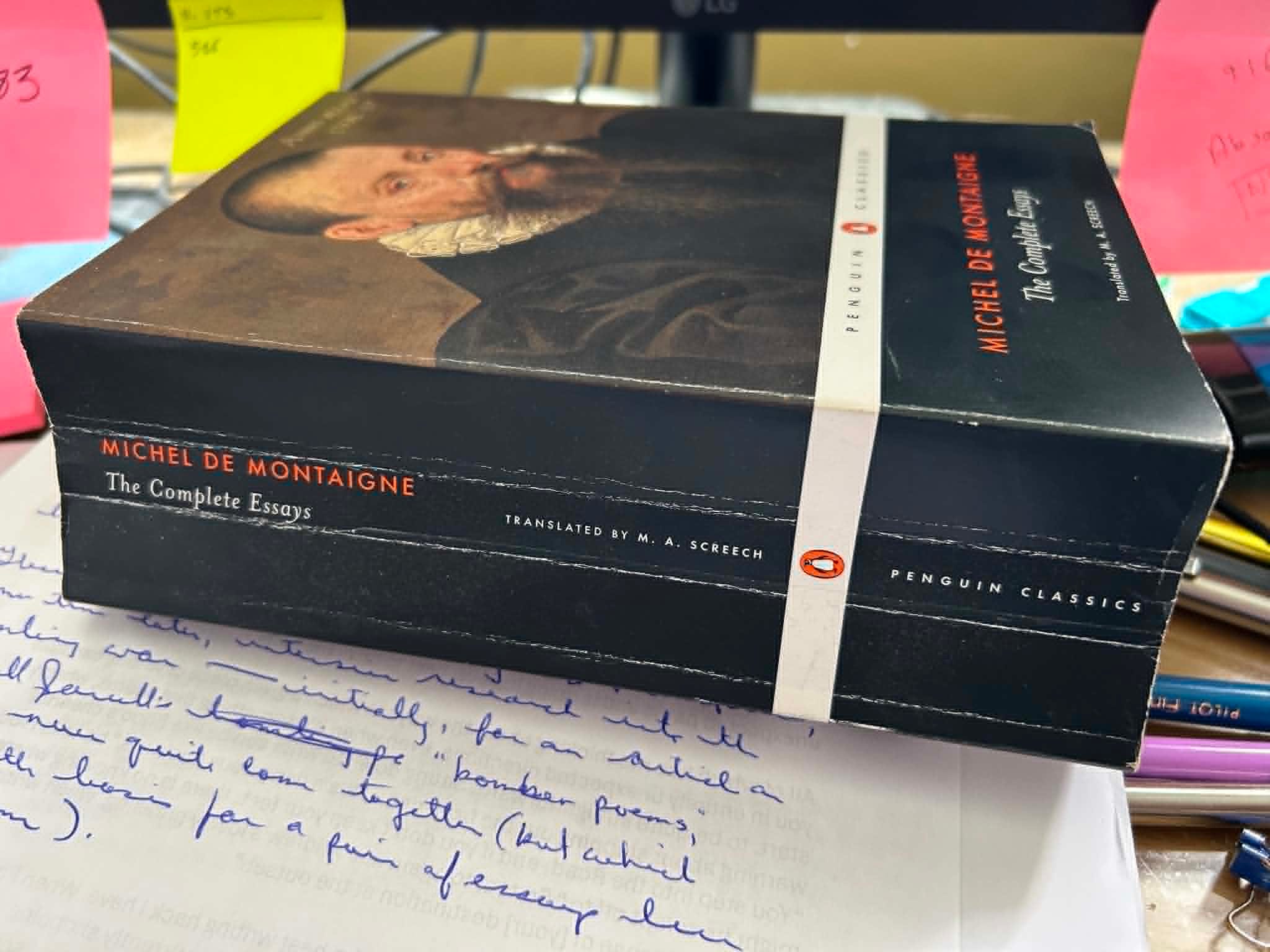
So we interrupt our scheduled essaying about expansive SF ideation to bring you an essay about essaying. And in case you were wondering, that’s why I have a picture of Michel de Montaigne at the top of this post. But more on that below.
II. For the past few months my Sunday ritual has been going to the gym for 9am and then meeting my friend Andrew after to have brunch, down a few pints, and exchange writing. You remember Andrew: he made an appearance two posts ago to talk about the multiverse in comics. He’s a great friend and English Department colleague, and he has a book coming out sometime soon, a collection of … well, I’ll get to that in a moment.
Most recently (this past Sunday) he sent me the book’s acknowledgements, in which he thanks everybody who helped in the writing, but also offers some context and background for the book. For several years now, he’s been posting lengthy Facebook updates that take the form of comic perorations picking up on fairly random topics and pursuing them to ends that are by turns parodic, satirical, absurd, or all of the above. For example: starting with the Coca-Cola ad that features two attractive young people at an Antarctic research lab, the coy love story takes a dogleg (pun intended) into an iteration of The Thing. Or that pre-movie feel-good Christmas ad about a young girl who watches movies with a snowman, whom she preserves year by year in an old fridge; in Andrew’s harrowing retelling, we get the snowman’s increasingly unhinged thoughts as he whiles away years in the cold and lonely darkness.
You get the idea. He’s performed some of these in stage shows and readings, and now we can look forward to seeing them collected in a book. (I’ll do some more focused log-rolling for it when its release is nigh.)
This is by way of context. In his afterword, he raises the question of just what to call these exercises. “Formally speaking,” he writes, “they’re an idiosyncratic lot, and maybe there’s no reason to impute unity to them at all.” He proposes a few possible ideas, but arrives at:
I’ve settled instead on “sallies,” a term that’s happily vague in its implications for form but still suggestive of experiment and play. Deriving from the Latin “salire,” to leap, “sally” evokes the circus and the diving board, the daring jump from one galloping horse to another, the virtuoso somersault. But it also acknowledges the risk of a trampling or a bellyflop. I’ve had a few of those. I haven’t included them in the book, though.
I quite love this designation, but it did oblige me to ask: how is this different from “essays” in the original meaning of the word? In its verbal form, “to essay” means “To attempt; to try to do, effect, accomplish, or make (anything difficult)” (OED). The essay in contemporary terms, especially those written for university classes, has calcified into a proscriptive form; its origins, however, lie in the sense of exploring, such as we find in the essays of Michel de Montaigne (1533-1592), whose writings are far more evocative of the sort of sallies Andrew describes, written, as he notes, “with only a hazy sense of their destination at the outset.” Reading Montaigne is an adventure, as you’re never entirely sure where a given essay is going to take you.
Of course, Andrew’s sallies are overtly inventive—though not fiction per se, they are fictional in their substance (mostly). As I mentioned to him when we met, the ones with a more satirical edge earn the moniker “sallies” for that term’s uses in military lingo, meaning exploratory, probing attacks—usually by a besieged force—to suss out the enemy’s strengths and weaknesses.
So, sallies it is. The book’s title is How to Annoy the King of Spain and is set to be released sometime this autumn. More on that when we’re close!
III. My writing here in the past month has developed along a general theme of what in my upcoming post I’m calling “hyperbolic worlds.” An infinite number of alternate multiversal realities? Vast, galaxy-spanning interstellar empires? The nigh-infinite resources needed to travel such interstellar distances? I seem to have visions of galactic excess on my mind.
The development of this theme across multiple essays was not by design. It wasn’t a deliberate decision on my part to follow my multiversal ruminations with a consideration of the implausibility of interplanetary empires; but having written the latter, it made sense to pick up my threads of thought on the fantasy of resources, just as I feel compelled now to dust off some old ideas about SF’s subgenre of unthinkably huge megastructures or planet-wide terraforming and construction. You’re currently reading this entr’acte because my megastructure essay has been taking me down some unexpected paths and is doing its level best to drive me batty.
All of which has me thinking about the ways in which a given piece of writing can take you in entirely unexpected directions, even when it’s something that seems, when you start, to be quite straightforward. Sitting down to write can be like Bilbo’s cheerful warning about stepping out the front door: “It’s a dangerous business,” he tells Frodo, “You step into the Road, and if you don’t keep your feet, there is no knowing where you might be swept off to.” So too, to again use Andrew’s lovely phrasing, when writing “with only a hazy sense of [your] destination at the outset.”
For me, having a destination is about the best writing hack I have. When I’m telling a story, I need to know how it ends. Both the novel I’m currently shopping and the one I’m currently writing came into focus for me when I could write the final scene in my mind.2 Hence, it was with a great sense of kinship that I encountered Terry Pratchett’s metaphor for writing a novel, which he likened to standing on the lip of a valley, peering across to your destination on the far side. You see where you’re going, but the valley below is shrouded in mist. Here and there hills and clusters of trees poke above the mist, giving you landmarks guiding your journey; presumably the trail is well marked in some places, while in others you have to hack and slash through undergrowth. And sometimes the trail unexpectedly forks. But you know where you’re going, or close enough to make no difference.
(On the other hand, I once shared my need to know how my story will end with a friend and colleague who is an award-winning author of numerous novels, and she was aghast at the idea of being so proscriptive in one’s writing. So your mileage may vary.)
Essays, however, are a difference species. I rarely know how I’m going to end things, and quite frequently when delivering a conference paper I’ve concluded by saying “And this is where my conclusion would be if I could write conclusions. Thank you.”3 This tendency is very nearly endemic at The Magical Humanist, to a large extent because I very specifically treat my writing here at least partly as works in progress. Hence a large number of my essays in this space end rather abruptly.
On the other hand, I’ve leaned into the more meandering qualities of essay-writing in the past year and a half. Maintaining a mostly-weekly posting schedule has (mostly) cured me of my old blogging habit of diving into an idea and feverishly writing several pages and then shelving it when I couldn’t stick the landing. Before starting The Magical Humanist, I had developed an embarrassingly larrge elephants’ graveyard of fragments and half-written pieces.4 Nowadays, the mostly-weekly habit has goaded me into sticking with an essay, even if it doesn’t resemble the original idea once I bring it to something resembling a conclusion.
The greatest salutary effect of this has been to remind me of a basic premise, one I repeatedly impress on my students: that writing, ultimately, is about process. A polished, finished product with which you’re happy is great, but its value lies in its contribution to a larger conversation, and in what it took to get you there. This in a nutshell is my principal beef with generative AI—it circumvents the process of writing and produces shit that, definitionally, has all been said before.
IV. Which brings me back to my header image, the patron saint of the exploratory essay, Michel Eyquem de Montaigne.
Montaigne wrote in sixteenth century France during a tumultuous period in which he was a landowner, a local magistrate, and, for a time, the Mayor of Bordeaux. He was a voracious reader, possessing a personal library of some fifteen hundred books, which he kept in a round tower on his estate. The tower was also his study: when he wasn’t riding his property and taking care of business both personal and political, he sat in his tower and read and wrote.
His writings were at once intensely personal and wide-ranging. As Sarah Bakewell writes in her critical biography of Montaigne How to Live (2010), in his essays he “presents himself as someone who jotted down whatever was going through his head when he picked up his pen, capturing encounters and states of mind as they happened” (3-4). He thus wrote “exploratory, free-floating pieces to which he gave simple titles” (3). “On conscience,” “On cruelty,” “On not pretending to be ill”; anybody familiar with Montaigne knows, however, that whatever general topic is named in the title isn’t necessarily going to remain the author’s focus throughout the essay. Quite often, especially in his longer ruminations, he lets his thoughts take him down a variety of paths whose forks and turns are suggested by intriguing elements in whatever he just wrote or quoted.
Quotations—obviously emanating from a mind crammed with the wisdom accrued from absorbing countless books—feature quite prominently and often come at you with no warning. He peppers his essays with such passages, usually dropping them into his writing mid-flow in precisely the way I tell my students not to.5 Nor does he really signpost his essays—they are genuine excursions along his ambling currents of thought, not polemical but investigative and interrogative. All in all, he breaks most of the rules I set for my students’ essays.
Given that he does not pursue overarching agendas other than, as Bakewell notes in her book, seeking answers to the question “how to live?”, there is no obvious philosophical project that announces itself. By the same token, Montaigne’s essays are profoundly philosophical, both in the sense of how they are steeped in philosophers ranging from Plato and Aristotle, the Epicureans and the Stoics, up to such contemporaries as Erasmus; and in their elemental, first-principles consideration of how to live virtuously and well. Taken in the aggregate, a sensibility emerges from his one hundred and seven essays: a humble humanism that values introspection and rumination, humane and generous behaviour, a love of reading, and the worth and indeed necessity of interacting with your fellow humans in good faith.
If and when I finally write my book on Terry Pratchett and magical humanism, there will be a chapter devoted to Montaigne and the consonance between his and Sir Terry’s worldviews as iterated over lifetimes of writing.
V. If Montaigne uses “essay” in the truly verbal sense of “to attempt,” the term has largely calcified for us into a proscriptive exercise, especially in the “keyhole” variant still ubiquitously taught in high school.
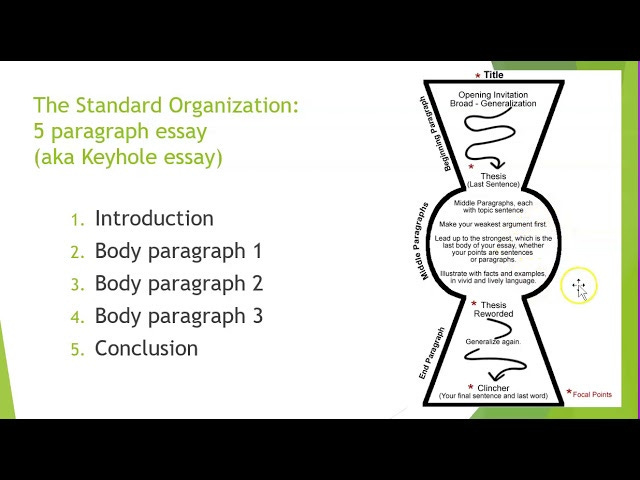
As I’ve written previously, the keyhole essay, while reductive, is not a bad thing; nor are its slightly more expansive university-level variants. The relatively rigid structure gives students still struggling with writing something on which to hang their thoughts, while more precocious writers can exploit the form to their advantage—like a talented poet with a sonnet—or, alternatively, it gives them something against which to rebel.
That being said, the longer I do this job the less enamoured I’ve become with proscriptive essays—both the peer-reviewed articles that are the coin of the professional academic realm, and the argumentative essays I’ve habitually assigned my students. Aside from the depredations of generative AI, which is effectively turning the traditional essay, pedagogically speaking, into a dead letter, I think a lot of the writing I have done here in the past year and a half has been a good lesson for me in the value of the informal essay. There’s a lot to be said for finding a happy medium between a scholarly academese and the purely personal rumination. Such indeed is Montaigne’s innovation: making the self the starting point, not as an exercise in solipsistic navel-gazing, but as the basis of a lifelong project of putting the self in conversation with other selves.
VI. Here on Substack I’ve encountered a lot of discourse on the longstanding writerly argument between pantsers and plotters. In the past I’ve also seen these personalities characterized as gardeners vs. architects. Gardeners are people who begin a project by scattering seeds and working with whatever grows; or, in the now more common lexicon, they compose by the seat of their pants, seeing what emerges. Their obvious opposites are the architects, the “plotters” who map out every aspect of their narrative, possibly on a whiteboard, detailing every granular element before sitting down to do the work of writing.
Though this opposition usually regards novel-writing, essays and non-fiction are also subject to the kind of happenstance that reliably gives plotters fits. Every academic I know, myself included, has had the experience of writing a five hundred or thousand word proposal for a conference paper, only to discover when sitting down to write it that it will absolutely not work as outlined. Ditto for the experience of a prospectus for a thesis; sometimes when I want to amuse myself or, alternatively, remind myself of the adage about God laughing at human plans, I revisit my original dissertation proposal.
I’ve thought for some time now that I’d like to trouble the simple opposition between pantsing and plotting by offering a third category: braising.
Braising is, as I wrote last year in “On Cooking Slow,” my favourite way to cook. There is something magical in the long, slow process of simmering unlikely or even distasteful ingredients over hours and having the alchemy of the process produce something genuinely delicious. Without rehashing6 the essay, I used slow cooking as a metaphor for thinking and creation.
As is often noted in the pantsing v. plotting debate, there probably isn’t a such thing as a pure pantser or pure plotter; they are the yin and yang of the creative process, with every pantser taking the occasional moment to plot out the next few steps, even if only mentally; and every plotter almost certainly has the experience of being surprised by the weirdly spontaneous turns their writing takes.
Missing from this equation however is the raw material of both processes, what Yeats called “the foul rag-and-bone shop of the heart,” and what Tolkien called the “Cauldron of Story.” That is to say: the stuff out of which inspiration emerges. I like to think of having a big pot in the back burner of my mind, always at a simmer, sometimes coming to a boil, working over the inedible lumps of ideas I dropped in weeks, months, often years ago. My completed novel currently in search of an agent had its point of origin when my wife and I drove past an old, derelict building that had once been a nurses’ residence. My wife, who is a health care worker and has a gothic-tinged fascination with abandoned buildings, said, “You should write a story about people who go into a building like that to take creepy photos, but who encounter real ghosts.” To which I replied: “Better yet would be people who try to do that, but for some reason always forget what they’re doing and come to themselves somewhere else entirely.”
That was some time in 2017. That thought went into the big pot, to be stirred and simmered. Time passed. Along the way, I taught my first course on Weird fiction, and started to develop a more serious research interest in H.P. Lovecraft and his legacy in the present moment. The thought occurred to me, apropos of being the second reader on a pair of creative writing honours essays, both of which were gothic horror set in Newfoundland, that this easternmost province should really be more of a hotbed of Lovecraftian weirdness. And then I taught Weird fiction again, and again. The simmering idea about the derelict nurses’ residence that supernaturally repelled people who approached morphed into a hospital an hour outside the city, which had once been a boutique Catholic hospice that ostensibly catered to elderly dementia patients, but also took in unmarried pregnant girls. The girls could have their babies away from prying eyes and rejoin polite society unblemished, while their illegitimate infants would be adopted … or were they? While in the present day the hospital sits abandoned and ignored, until its property catches the eye of a shady real estate developer.
By late 2022, I’d almost arrived at a point where the stew in that pot was ready. But there was a missing ingredient. Then one day as I walked to the gym, the ending presented itself to me and everything came into focus—at which point I knew I’d be devoting the winter term of 2023, which I’d cleared of teaching, to writing this novel.
And though the destination was clear in my head, the writing of it was endlessly surprising. Characters I’d never planned on appeared in my text and said hi and took up residence. Stuff happened along the way that totally took me by surprise, all the while my narrative moved inevitably to the ending that had announced itself in the teeth of a November wind as I walked past a construction site.
But it had all emerged from that back burner pot, which had been blipping innocuously along for almost six years while its ingredients fused and merged. I plotted some, I pantsed a bit, but really the substance of what I wrote was the product of a long mental braise.
For today’s cat, here is Catesby (felis flooficus) staking out her place on our new couch.

REFERENCES
Bakewell, Sarah. How to Live: A Life of Montaigne in one question and twenty attempts at an answer. Vintage, 2010.
NOTES
Well, fifteen days. I started writing this May 31, thinking I would knock it out in an afternoon, and here we are on June 4. I’m currently in a writing-is-like-pulling-taffy phase.
Though for me it’s important not to actually write it until I get there. Holding it in my mind is like celestial navigation, acting as a guide. More practically, as per the theme of this essay, it would be premature to skip ahead and write the end. There’s too much that’s constantly changing, evolving, and surprising me in the process of writing my way there. Holding the ending in my mind as potentiality means I don’t have to entirely rewrite it when I get there. Also, there’s the reward factor: it’s absurdly gratifying to write when you arrive.
Conversely, I am very good at titles. I will often think of a title for a piece before having a clear idea of what its substance will be. Sometimes this works well for me. Oftentimes it means I hit on a title I love which then has to ferment in the basement of my mind until I’ve developed enough of an argument to make a proper go of writing it.
This graveyard has proven invaluable in this space, as it is now a resource for when I have no obvious topic on which to write next. I’ve dusted off a bunch of old, disused, and fragmentary essays and breathed new life into them: “George R.R. Martin vs. Destiny”; “WWII’s Blinding Mirror”; “Tolkien’s Uncanny Magic”; and what is now my most-read essay, “The Implausibility of Galactic Empires”—all had been mouldering away in various stages of completion in my “In Progress” folder.
One of my iron rules for quotations: Introduce→Contextualize→QUOTE→Comment.
See what I did there?
Always love reading your posts -- on any topic -- but I especially love when you talk about your writing process (writing processes and the people who struggle with them are one of my favorite topics).
I love this simile: "For whatever reason, writing these essays has been like pulling teeth. The one in process is like pulling teeth that are all running off madly in all directions."
I recently described my revision process on my recent feminist killjoy bibliographic essay (which went on far longer than I had planned, or could have known) as ongoing wrestling with a big tentacled creature (yes, I was envisioning the Watcher in the Water) who was having way too much fun with the game and didn't want to stop.
And part of the problem was I realized that only ONE of all the essays either talking about how feminist Tolkienists hate Tolkien (and no doubt all men), or those doing what I consider a feminist analysis of some aspect of Tolkien's work (who in fact never expressed hatred of him or his work) ever defined what they meant by "feminist." (For those interested in the one who actually provided a definition and used a feminist theorist: see Power in Arda [https://dc.swosu.edu/mythlore/vol21/iss2/40/]).
And for academic scholars, that's a pretty big gaping gap.
So I had to write one. And that's when the tentacles came out!
If that’s just a quick filler while you’re pondering your real next essay, my hat is off to you.
Terry’s quote about the mist-filled valley had come to my mind before I reached your reference to it. It is a favourite of mine. And my favourite part of it is this: “And with any luck you can see the other side of the valley.” Because that makes the whole thing conditional. I’ve often wondered how much his own glimpse of that far side varied from one book to another. To take two of my favourites, I’m guessing he saw it clearly in Wyrd Sisters… but maybe more hazily with Monstrous Regiment. But who knows?