
On Gremlins
A brief history of sky goblins

I. I’ve been thinking a lot about gremlins lately.1
This isn’t unusual for me. Watching the “Nightmare at 20,000 Feet” episode of The Twilight Zone: The Movie (1983) when I was eleven was one of those terrifying viewing experiences we sometimes have when we’re young that rewires something in your brain. It disturbed my sleep for months afterward, and I’ve still never seen the 1984 film Gremlins.2 At the same time, the idea of a malevolent creature who plagues airplanes has always been a source of fascination to which my imagination has often returned.
If I’ve been thinking more frequently about the little bastards in the past few years, the reason is twofold: (1) a few years ago, when teaching a graduate seminar on weird fiction, I made the first assignment a personal essay in which students would write about a formative experience of watching or reading something that terrified them beyond what was strictly reasonable; in the spirit of fairness and by way of example, I wrote my own about my Twilight Zone trauma. And (2), my interest in the bombing war of WWII by way of the poetry of Randall Jarrell made gremlins something of a potent metaphor.
The research into Jarrell’s bomber poems and the larger history of the bombing war more generally went off in a few directions, leading to a copious amount of notes and rough drafts for an article that remains unfinished because it keeps getting away from me (though you can see some of my thinking in two of my war poem essays from last November, here and here); it has also, hopefully more fruitfully, provided the basis for my current sabbatical project, in which I’m writing a novel loosely based on my maternal grandfather’s war service as a bomber navigator.
What does this have to do with gremlins? Well, let’s get into their origin story as a bit of modern folklore.
II. Gremlins, as I alluded to above, are creatures that plague airplanes. In the Twilight Zone episode, based on a short story by Richard Matheson (author of I Am Legend [1954]; he also wrote the teleplay),3 a man who is a nervous flyer is on a plane during a storm. Looking out the window, he sees … something. At first, he thinks his eyes are playing tricks, but then he sees it again. And then again, and each time it becomes clearer that there is a person-shaped thing out there on the wing. Panicked, he calls for a flight attendant, shouting “There’s a man on the wing of this plane!” This, of course, is impossible, and it is obvious that the fight staff and his fellow passengers think him hysterical (it doesn’t help his case that the segment begins with a flight attendant talking to him through the bathroom door as he’s inside having a panic attack). After talking himself down, realizing it would be impossible for a man to be on the wing at this speed and altitude, he accepts a valium from the senior flight attendant, closes the window shade, and attempts to sleep.
Of course, after a fitful attempt, he can’t help himself, and he opens the shade … and sees the thing, clearly demonic in appearance now, inches away from his face on the other side of the window.
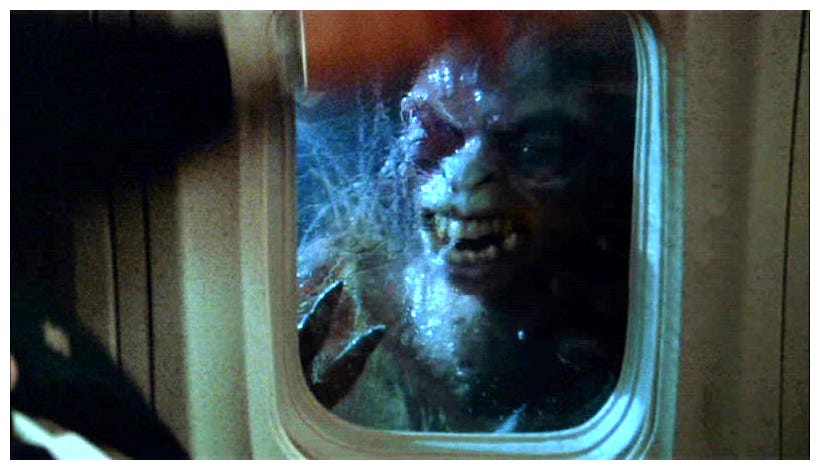
This was the precise moment it broke my brain and gave me nightmares for months.4
Anyway, TL;DR: either through turbulence or the creature’s sabotage, the plane lurches violently. The man grabs a gun from the sky marshal and shoots at the creature through the window. The cabin decompresses and he’s sucked out halfway. He shoots at the creature again, which wags a clawed finger at him, and flies off into the night. The plane lands and the man is taken off in a straitjacket, all the while maniacally screaming about the gremlin; meanwhile, the mechanics examining the plane’s engine find it torn to shreds, the metal bent and ripped and covered in deep rents that look like claw marks.5
III. There’s surprisingly little written about gremlins, which is possibly a function of the twinned facts that, on one hand, they’re basically a sub-species of a vast array of pixies, fairies, goblins, imps, and other mischievous fey creatures from folklore and legend; and on the other hand, they have a recent and fairly specific point of origin. Gremlins emerge alongside aviation (something The Twilight Zone hews to, and the movie Gremlins ignores). More specifically, gremlins are creatures of the RAF and start appearing as an explanation for random malfunctions sometime in the 1920s, becoming a staple of flyers’ mythos by the outbreak of WWII.
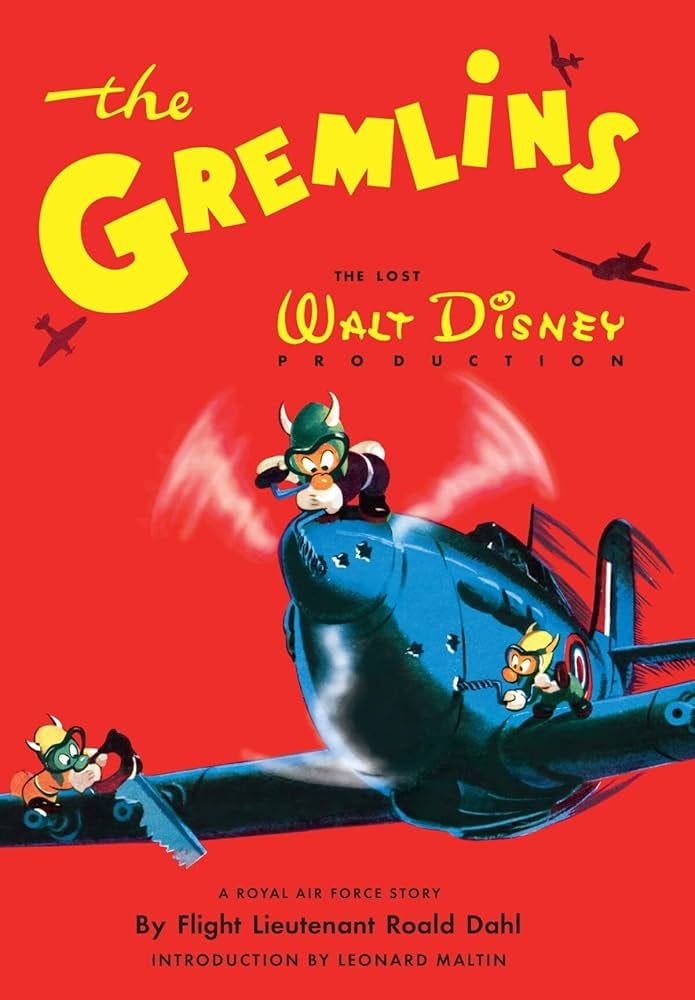
Gremlins, indeed, almost became the subject of a Disney film: author Roald Dahl, who would go on to write Charlie and the Chocolate Factory (1964) and James and the Giant Peach (1961) among innumerable other beloved children’s books, was an RAF pilot. His first book was titled The Gremlins, about a British Hawker Hurricane pilot named Gus who is first tormented by gremlins but ultimately befriends them and convinces them to use their technical savvy to help the British war effort. In 1942, Dahl was invalided out of active service and sent to Washington, D.C. as an RAF attaché. The Gremlins brought the RAF mythos of airborne imps to America and was popular enough that Disney optioned it as an animated feature. Though Disney ultimately did not make the movie, Dahl convinced them to publish it with the animators’ illustrations in 1943. First Lady Eleanor Roosevelt reportedly delighted in reading it to her grandchildren.
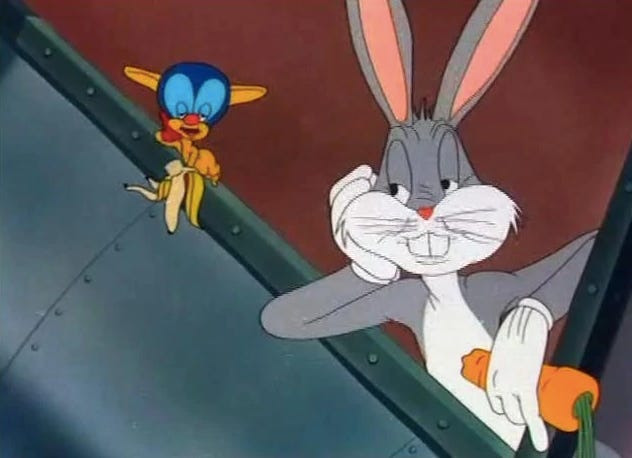
There was also a Loony Toons short in 1943 featuring Bugs Bunny being bedevilled by a gremlin on a U.S. airbase.
Though Dahl would later claim to have coined the word “gremlin,” that is demonstrably false, as the term was in use from the 1920s and was featured in Pauline Gower’s 1938 memoir Women with Wings. Gower describes one variation of the legend:
Country that was particularly high or enveloped in cloud became known among the pilots as Gremlin country. Chambers told us the old Air Force legend of the Gremlins. These are weird little creatures who fly about looking for unfortunate pilots who are either lost or in difficulties with the weather. Their chief haunts are ravines and the boulder-covered tops of hills. They fly about with scissors in each hand and try to cut the wires on an aeroplane. The pilot hears them coming, snapping their scissors, and does his best to get out of their way. Usually they climb on one wing and the pilot manages to shake them off. Then they attack the other wing, and again he may manage to dislodge them by banking sharply, only to find that they have clambered on to the tail, the petrol-tank, and along the fuselage. (200)
Desperate to find a landing spot, but surrounded by clouds and fog, pilots often then turn in circles until they put themselves into a spin and crash. “The Gremlins then fly off,” Gower writes, “content at having slain yet another intruder of their country” (200-201), though she allows that she does not know “if this is the generally accepted version of the legend.”
IV. The etymology of “gremlin” is difficult to determine, with some suggesting it comes from the Old English word gremian, “to vex,” which is also possibly related to gremmies, British English slang for goblin or imp. Another theory holds that the word is a conflation of goblin and Fremlin, the latter being a popular brand of beer widely available on British airbases in the mid-century—one can imagine tales of mischievous airborne creatures characterized as goblins seen after too many Fremlins.
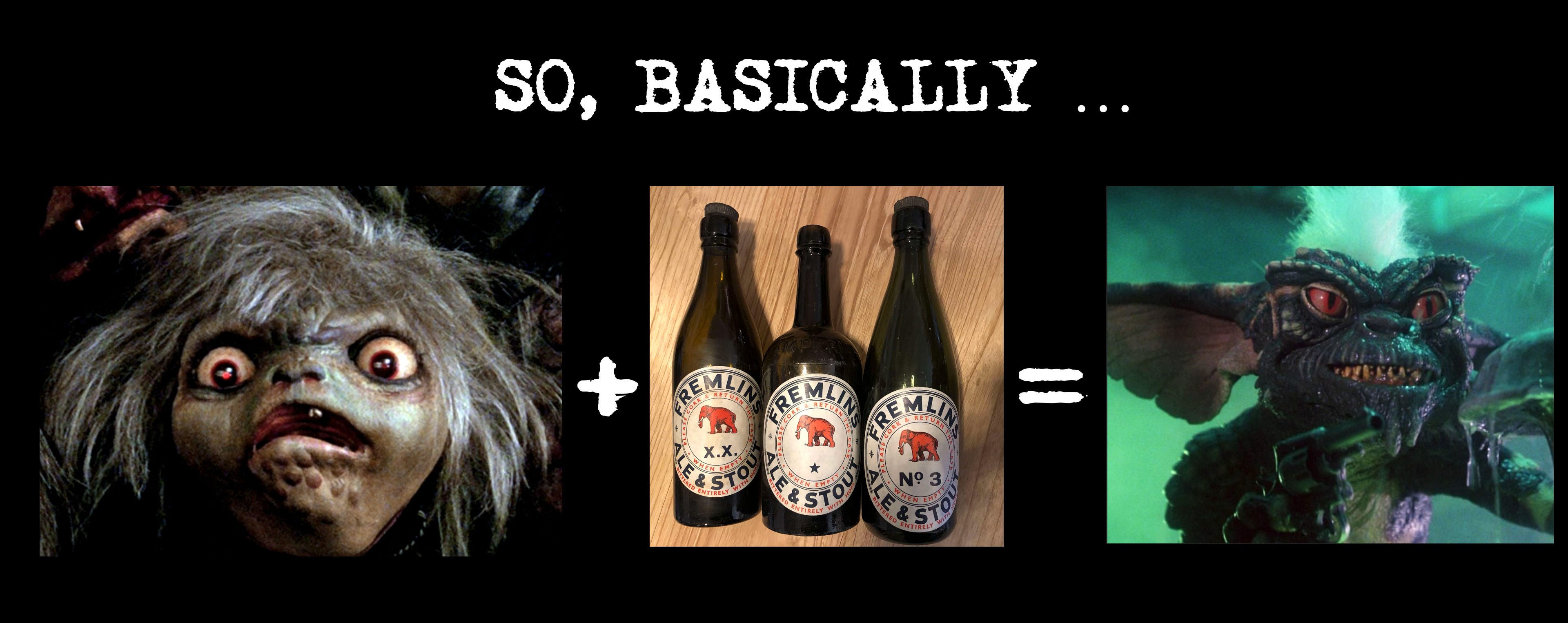
One of the more interesting aspects of the gremlins mythos is how many flyers seemed genuinely convinced of the creatures’ existence. So common were tales of malfunction attributed to gremlins that U.S. aircrews stationed in England picked up on the lore and many of them, like their British counterparts, swore up and down they’d actually seen the little bastards working their mischief. Indeed, one of the only academic pieces of writing I’ve been able to find on gremlins is not the work of a folklorist, but a sociologist: in a 1944 edition of The Journal of Educational Sociology, Charles Massinger writes gravely about the fact that “a phase of thinking that had become prevalent in the Royal Air Force”—which is to say, gremlins—“had subsequently infected the psychology of the American airmen in the present war.” Massinger’s article expresses concern that otherwise rational people, thoroughly trained in advanced aviation, who necessarily possess a “breadth of … scientific knowledge relative to cause and effect of stress on the fighting machine” would be so irrational as to actually believe in the existence of “fantastic imps.”
Massinger suggests that it is the stress of combat that gives rise to such fantasies, which is not an unreasonable hypothesis—war zones are notoriously given to all sorts of fabulation. But he says that it is the stress and fear in the moment, in which split-second decisions and reactions that don’t allow for measured and reasoned thought, that short-circuits the sense of reality: “If pilots had sufficient time to think rationally about machine deficiencies under actual flying conditions,” he says, “it is doubtful whether the pixy conception would have crept into their psychology.” Leaden prose aside, this argument strikes me as precisely wrong. The mythology surrounding gremlins may have had its start in panicked moments of crisis while aloft, but it developed and deepened in moments of leisure—airmen relaxing between missions in the officers’ club or mess, presumably over numerous bottles of Fremlins. It is indeed with just such a scene that a pilot first shares his gremlin encounter with his fellow fliers in Dahl’s story, after which
The word was to spread through the R.A.F. like a prairie fire. It would travel over the seas to pilots in Malta, to the desert airdromes of Libya and Egypt and to remote landing grounds in Palestine and Iraq. Some mentioned it in India and someone else in Ceylon—and now they all had it—
IT WAS A VERY FAMOUS WORD.
Though Dahl claimed coinage of the word, and indeed in his story his Hurricane pilot Gus invents the word on the spot after his initial encounter, it was a fairly famous word by the time the war began, at least among RAF flyers. And he is correct here in how it spread like an infection, with American airmen picking up the legend.
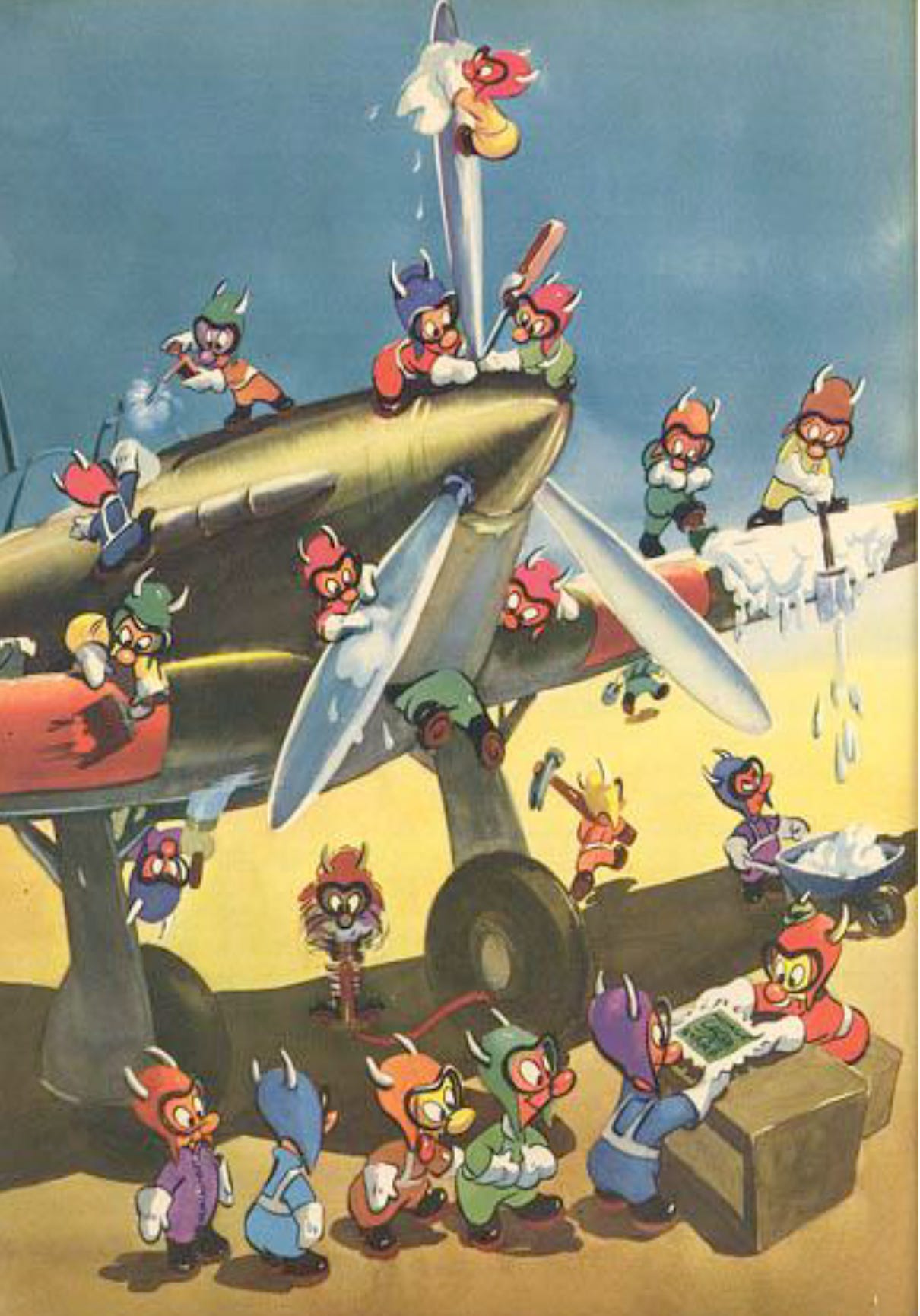
V. That very virality gives the lie to Massinger’s suggestion of spontaneous panic in the moment that short-circuits rationality as the beginning and end of the gremlin delusion. He’s not wrong about the idea that airmen responded to the stresses of combat and the frustrations of frequent baffling breakdowns with fantasy rather than reason. What he’s missing, rather, is the way in which mess-hall fabulation humanizes the experience; the rationality of science and technology in such situations, I would hazard, is not a comfort, no matter how long the flyers have for reflection. The mechanical dimension of air combat is the alienating factor, especially at a point in time when flight was not just new but evolving by leaps and bounds. Roald Dahl’s experience in this respect is instructive: he started the war flying Gloster Gladiator biplanes, which were badly obsolete even when they were first introduced in 1934. By the time he was invalided, he had graduated to Hawker Hurricanes, which in the early days of the war were among the most advanced fighters. By the time he was in the U.S. and Eleanor Roosevelt was reading his first book to her grandchildren, the Allied bombing campaign had already lost more planes than flew in total during the First World War, with the new planes coming off assembly lines not just matching the losses but growing the massive air fleets.
As I suggested in my essay on Randall Jarrell, the heavy bomber is a potent metaphor because of its contradictory, almost paradoxical nature: on one hand a symbolic apex of military flight technology, capable of delivering a devastating payload of death and destruction from 20,000 feet or higher; and on the other hand uniquely vulnerable not just to anti-aircraft fire and enemy fighters, but to their own fragilities. Breakages and breakdowns were endemic; altimeters and other gauges often lied; ice on the wings could be deadlier than fifty calibre shells; airmen suffered as much from hypoxia and frostbite as from enemy fire; and one of the deadliest nights for the RAF occurred not at the hands of the Luftwaffe but from fog. On the night of December 16/17, 1943, which came to be known as Black Thursday,6 thirty-seven bombers crashed or were abandoned by bailing crews when opaque fog rolled in over the entirety of Britain while the planes were still over Berlin.
It is thus perhaps unsurprising, as recounted by Pauline Gower, that gremlin activity was most often associated with terrible weather, when a much greater frequency of accidents and breakdowns occurred—or that the Twilight Zone episode that terrified eleven-year-old me takes place in the midst of a thunderstorm.
VI. Air travel has become so rote and banal today, and catastrophic airframe malfunctions so rare,7 that it is difficult to imagine what must have been a vastly disorienting experience in WWII with ever-more sophisticated fighters and bombers that were nevertheless plagued by constant mechanical failures. That precarity was also reflective, however, of the first tentative steps into the new frontier of the sky. Gower’s breezy description of gremlins has one telling line: “The Gremlins then fly off, content at having slain yet another intruder of their country.”
Their country—the sky, in other words, is the domain of the gremlins, into which these newly-bewinged humans are trespassing. Dahl offers a somewhat similar perspective. In his gremlin origin story, he tells of a time when “England … was a country of dark forests and greasy swamps, and all the land was shrouded in a thin white mist,” and the “forests and swamps were full of goblins and trolls and hobgoblins and pixies.” The arrival of humans was predictably deleterious for the indigenous fey folk; though Dahl does not share the fate of the terrestrial pixies and hobgoblins, he tells of one group that retreated to tall hills, and when even those remote locales were invaded, they took to the sky. The advent of airplanes made them vow to always harass the humans in their “tin birds.”
It’s worth emphasizing again that, whatever DNA gremlins share with goblins and kobolds and other trickster little folk of folklore, their own folkloric origins are inextricable from flight technology. In this respect they are an eminently modern legend, and one similarly living in a narrow historical era between the first airplanes and the moment at which airplanes became safer than cars. As imaginative creations, gremlins are to flyers what the sea monsters decorating the fringes of old maps were to early mariners: the dangers of unmapped territory given stark and terrifying form and imagined not as random hazard but original territorial inhabitants defending against interlopers.
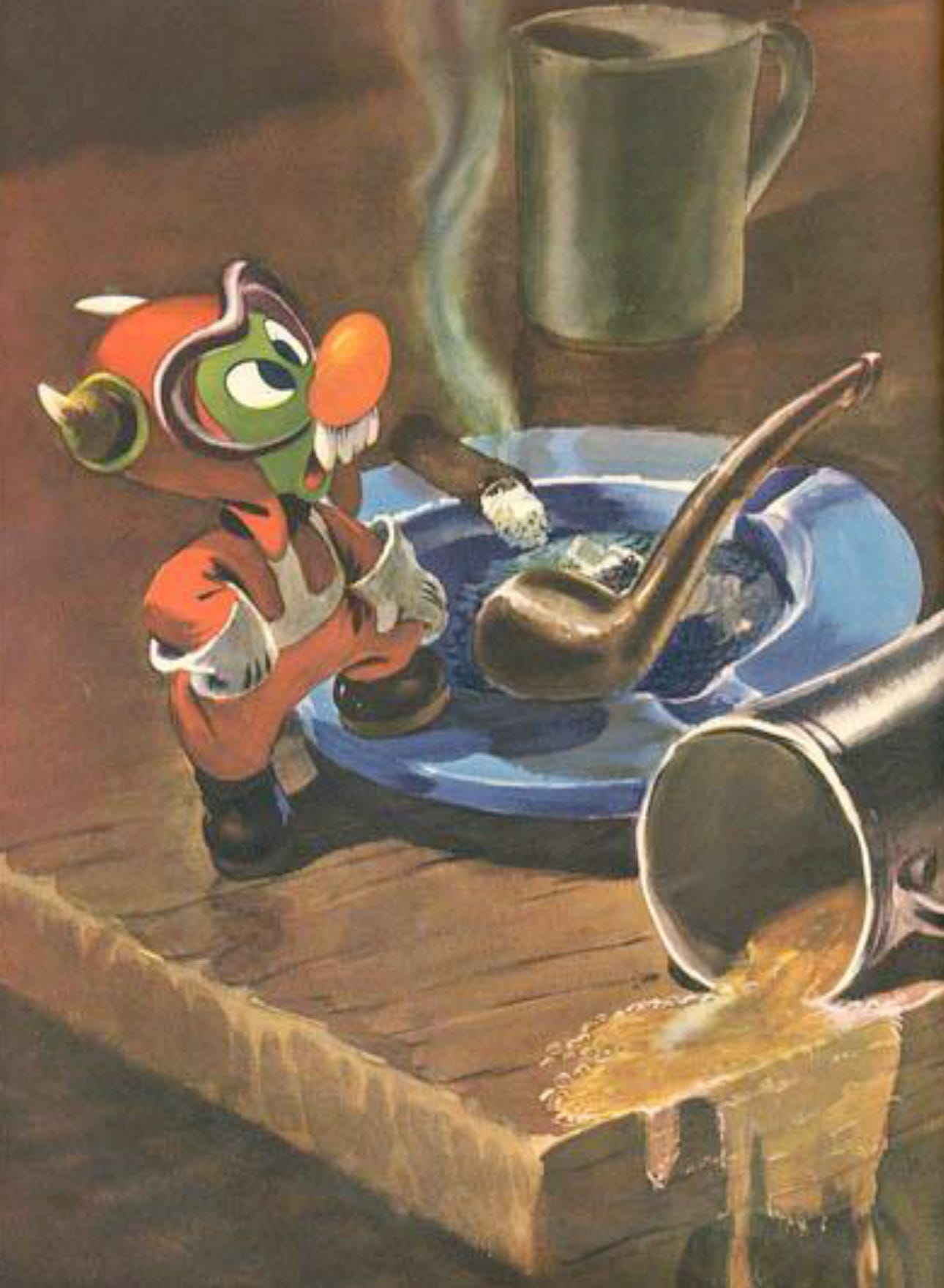
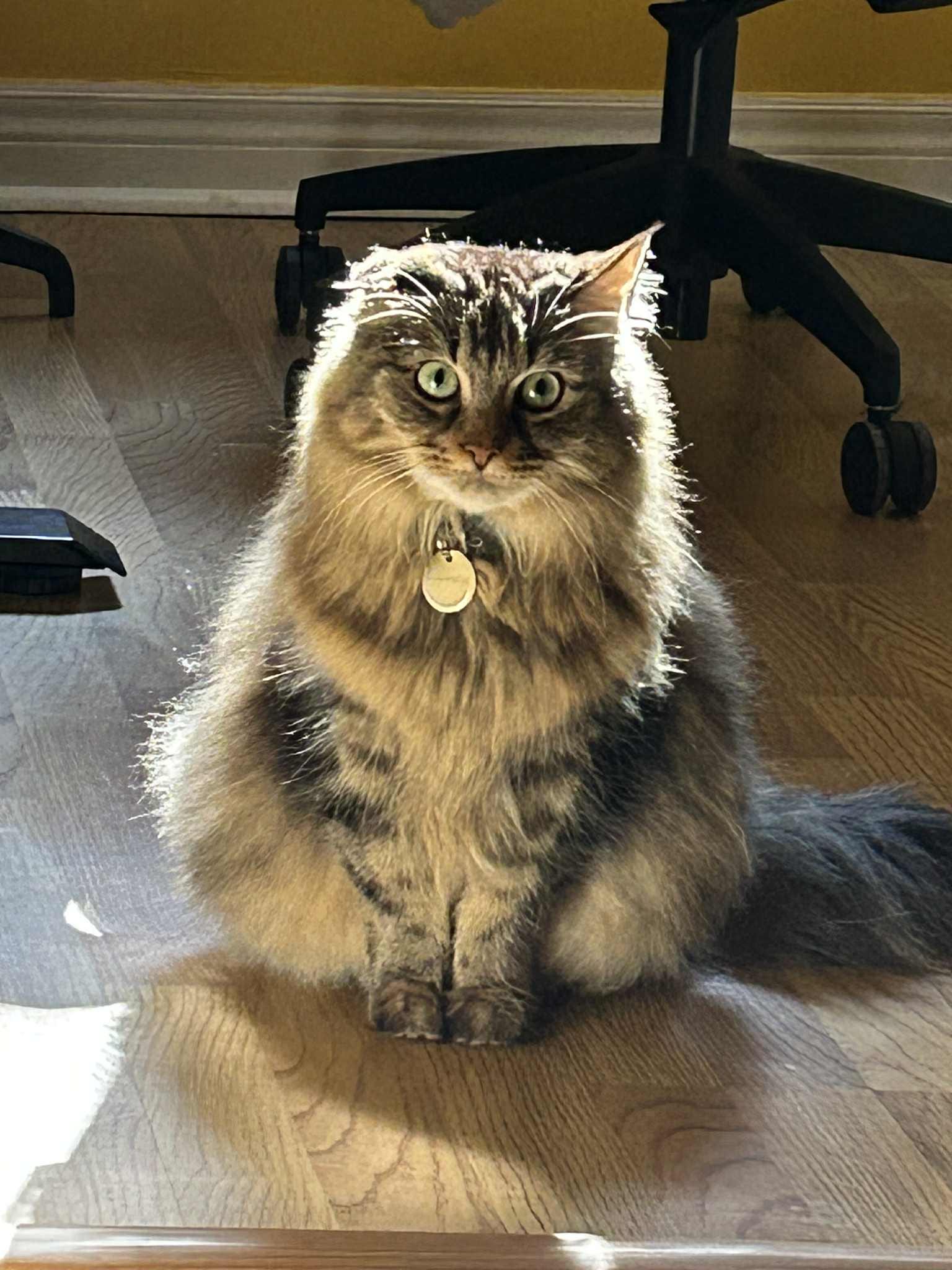
In our house we are plagued by couch gremlins. I mean, look at this fearsome thing.
REFERENCES
Donald, Graeme. Sticklers, Sideburns, and Bikinis: The Military Origins of Everyday Words and Phrases. 2008.
Gower, Pauline. Women With Wings. John Long, 1938.
Leach, Maria (ed). The Dictionary of Folklore. 1985.
Massinger, Charles. “The Gremlin Myth.” The Journal of Educational Sociology. 17.6
(1944): 359-367.
Rose, Carol. Spirits, Fairies, Gnomes, and Goblins: An Encyclopedia of the Little People. 1996.
NOTES
Full disclosure: this essay is cannibalized/adapted from something I wrote on my old blog in May 2022.
I did ultimately watch the original black and white Twilight Zone episode, which aired in 1963 and featured a pre-Star Trek William Shatner as the nervous flier who spies the gremlin on the wing. I often wonder if I’d seen that version first if I’d have been quite so scarred, considering that its gremlin is more risible than frightening, looking like a man in a bad monkey suit.
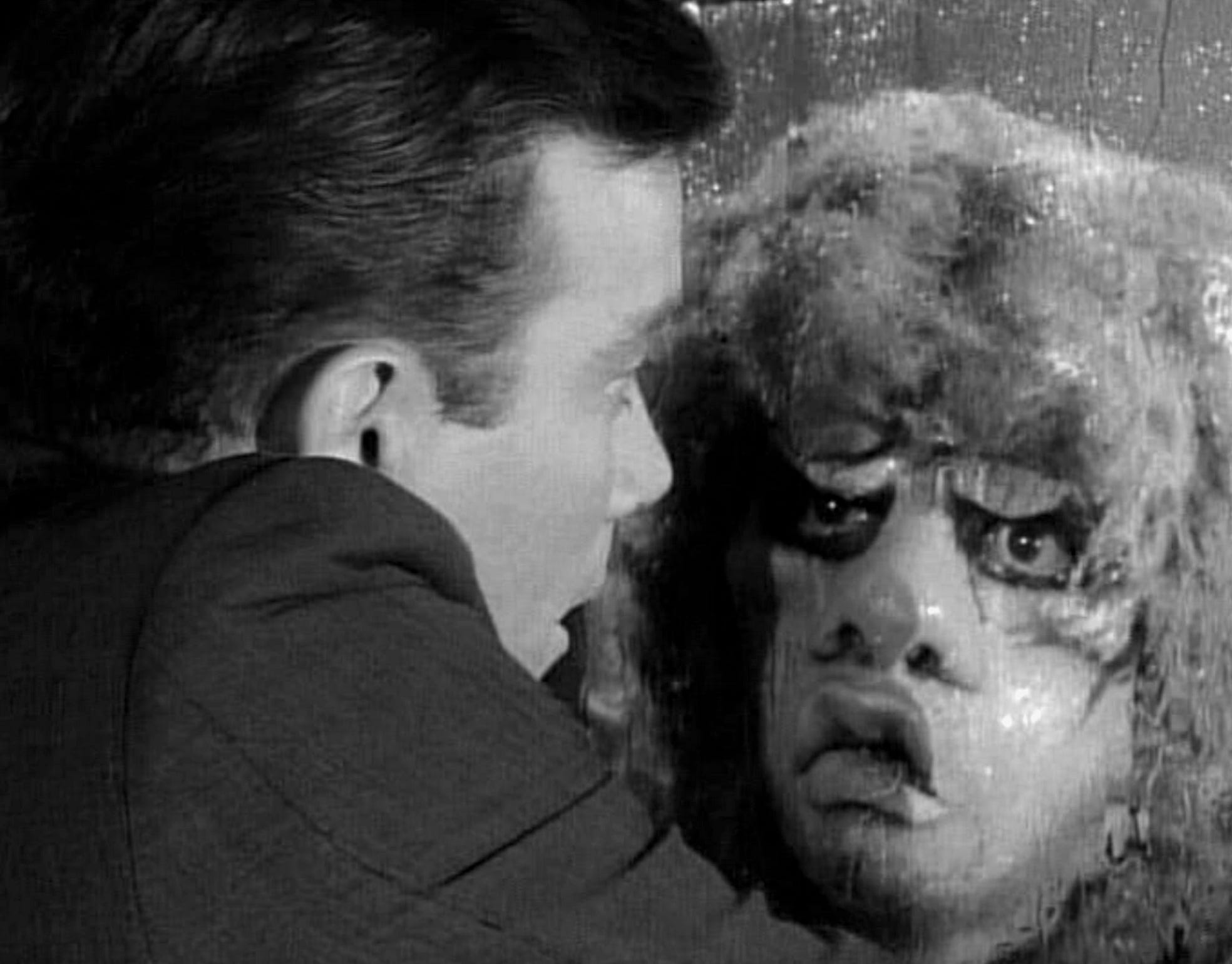
It’s one of the better-known episodes, and probably familiar even to those who haven’t seen it—not least because it was parodied in a Simpsons Halloween episode.
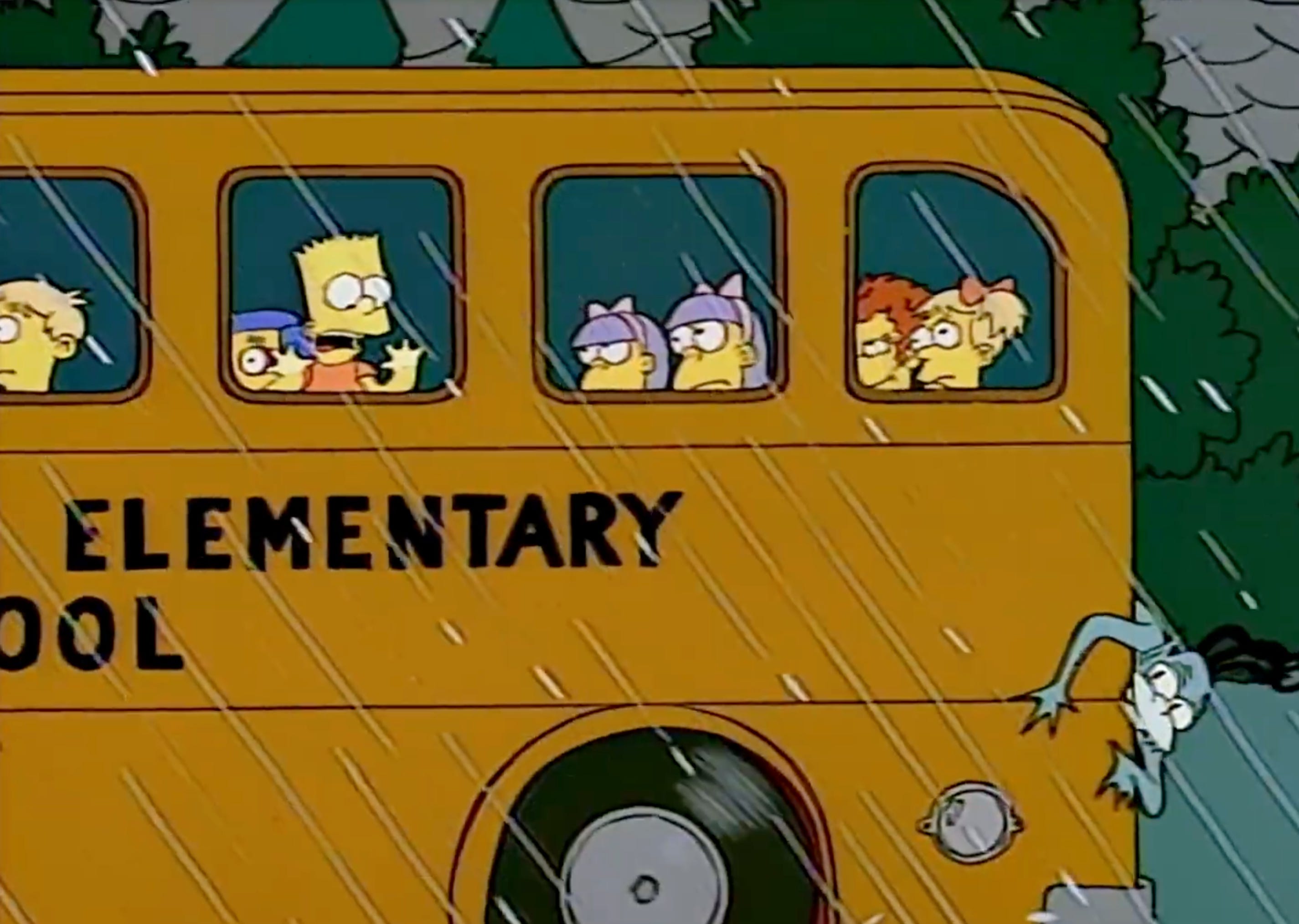
The original episode, with its less demonic-looking gremlin, doesn’t pack quite the same punch. It is, however, still the scariest part of the episode.
For the sake of simplicity, I’m not differentiating here between the original episode and the version from the 1983 film; though there are some minor differences in the sequence of the action, they’re similar enough that it doesn’t much matter.
Not to be confused with the Black Thursday of October 14 of the same year, when the USAAF suffered huge losses bombing Schweinfurt, or the Black Thursday of April 12, 1951 when 25% of the B-29s in Korea were destroyed by enemy MiG-15s.
Boeing’s recent run of problems notwithstanding—the offending 737 MAX still has an overall better safety rating than your average 1940s military airframe, even leaving out the compounding issue of people shooting at you.
Did you ever listen to the CBC's satirical radio show 'Double Exposure' in the nineties? I only recently discovered that its memorable closing music was, randomly, the theme from 'Gremlins'.