
Thinking the Popular
Gearing up to teach pop culture this year (twice)

I. Many years ago—about twenty-two or -three, to be more precise—when I was in the later stages of my PhD and teaching on a per-course basis to pay the rent, I was fortunate enough to teach my department’s first-year course on popular culture. I taught it twice, in 2003-2004 and 2004-2005. It was the largest class I’ve ever taught, with 150 students the first time and 250 the second. I had TAs, even!
Fast-forward to fall of 2016, when I taught another variation on it. “A Critical Introduction to Popular Culture” is a second year required course for students majoring in Communications and Media Studies (CMST) here at Memorial University. I taught it again the following autumn, then didn’t teach it again until fall of 2023, and I’ve taught it every year since, and will almost certainly be teaching it every year until I retire.1
This year? I’m teaching it twice, once in the fall term, and again in the winter.
I start every new class, after I’ve distributed and talked through the syllabus, with two items. One, I do a close reading of “Livin’ on a Prayer” by Bon Jovi as an example of how a pop cultural artifact that seems, manifestly, to be about one thing can also express its effective opposite; how it can appear to be a protest against the inequities of its historical moment while simultaneously reinscribing its prevailing, normative zeitgeist.2 But before I get to that, I share an anecdote from the first time I taught pop culture back in my grad student days at the University of Western Ontario.3 A close friend of mine, a doctoral student in philosophy, invited me out for an evening of bar-hopping with a handful of his fellow grad students. We pre-gamed at his apartment, which meant making small talk with a bunch of aspiring philosophers. That is always a bit of a mixed bag, depending on the kind of philosopher you end up talking to. I chatted at one point with an affable enough fellow, and I asked him what sort of teaching he was doing. Oh, just your basic Philosophy 101, he said. And me? Well, I started to reply and paused. “I’m teaching a course on popular culture.”
Ah, he said, and gave me a quizzical look. “But … is that something you really need to teach them?”
By which I took him to mean: our students are already immersed in popular culture, probably more than us. In what way is such a class at all reflective of the sort of intellectual rigor a university education ostensibly imparts? And lurking beneath that question is the assumption that any such class is really just a bird course that does not tax students’ minds and provides university departments with easy, large-enrolment cash cows.
Well, I won’t deny that such courses as pop culture certainly do a good job of getting bums in seats. The attraction of watching movies and TV and getting a university credit for it sounds like a lark. Certainly, watching The Simpsons and The Matrix (both of which I did in those courses) is rather less taxing than reading, say, Aristotle or John Hume in my friend’s philosophy course. And as he observed, it’s not as though I’d be introducing Bart and Marge and Neo to my students.
But that’s not the point of the class, I said.4 In Philosophy 101 or something comparable, yes, you’re likely introducing students to something new. Maybe you’ve heard of this Aristotle guy, you might say, but you probably haven’t read him or know much about him. So let me tell you …
If teaching many subjects is a process of familiarization, the teaching of popular culture is very much one of defamiliarization. It is structural and theoretical more than it is about content—it actually matters little what examples I use. The finer plot points of a given episode of I Love Lucy or Friends matter not at all except in how they exhibit a structural consonance. In the former it was a minor scandal to have Lucy tell Rickie she was pregnant, while Ross has to go to great lengths to (unsuccessfully) hide his fling with the photocopier girl from Rachel. Though sexual and cultural mores change, the basic dynamic of sitcoms does not—there’s a misunderstanding of some sort, or somebody transgresses in a non-egregious manner and, instead of just fessing up, goes to elaborate lengths to conceal or fix things. Hijinks ensue.
Part of the exercise is to make these structural elements clear and show how they manifest the different medias’ economic preoccupations while also articulating the cultural and societal preoccupations of the moment, how they act to critique or reinscribe the moment’s normative discourse (often both). Popular culture, I say in my introductory lecture, doesn’t want you to think about it. So let’s spend the next twelve weeks thinking about it, developing a toolbox of reading strategies to better help cultivate—to borrow an expression from Noam Chomsky—your intellectual self-defence.

II. Of course, popular culture is not without its paradigm shifts; one might indeed argue that popular culture is nothing but paradigm shifts, basically an accelerated series of transformations in step with the technological advances of its hardware: radio to cinema to television; within television, from broadcast to cable to streaming; in music, from vinyl records to tape to CDs to MP3s to streaming, and the rise and decline of radio as the principal method of dissemination; the ever-evolving technology of movie making from silent to sound to colour, from practical effects to CGI; the rise of the internet and its slow then sudden supplanting of traditional media, bringing us to the current morass of social media and YouTube and TikTok, which have had material impacts on the craft and creation of TV, film, and music. And I’m not even getting into the quarter-trillion dollar behemoth of the video game industry5 and all the cross-pollination that happens there.
The question I find myself mulling, as I start to pull my material together for my fall’s pop culture course, is how substantive or superficial these many paradigm shifts have been. In one sense, for however revolutionary the change from radio to television was, it didn’t effect much structural change. The earliest TV series were frequently adaptated from radio shows—Gunsmoke, Ozzie and Harriet, The Adventures of Ellery Queen, The Jack Benny Program, and The Lone Ranger, among many others, comprised a significant portion of early television’s nightly programming.6 The nightly news, along with public-interest informational programming, were delivered in more or less the same formats, except that now you could see who was talking. This visual dimension put a new premium on the attractiveness of the hosts, but that was cosmetic and wasn’t (yet) a gamechanger.7
The rapid transformations of media over the course of the twentieth century—really, in the post-WWII period—have arguably been more a matter of amplification than structural change. Which is to say: there’s so much more of it, across platforms both new and old, that the sheer scale of the industry makes it inescapable in ways it wasn’t before. Industry, indeed, is the operative word here, as in “the culture industry” as theorized by German critical theorists Theodor Adorno and Max Horkheimer in their defining mid-century essay of that title.8 Oversimplifying radically, their basic argument is that when culture becomes an industry, i.e. when creative cultural production becomes driven by the profit motive at scale, the principal determining concern becomes maximizing the size of the audience. Hence the product (art) is tailored such that it appeals to the largest possible number of people, making it by necessity inoffensive, familiar, and safe. What results is a narrowing of the artistic potential of creative production such that a given product—whether it be a film, musical act, new car, etc.—will differ only superficially from other such products.
It is at this point in the lecture when I often show a series of slides of boy bands through the years.
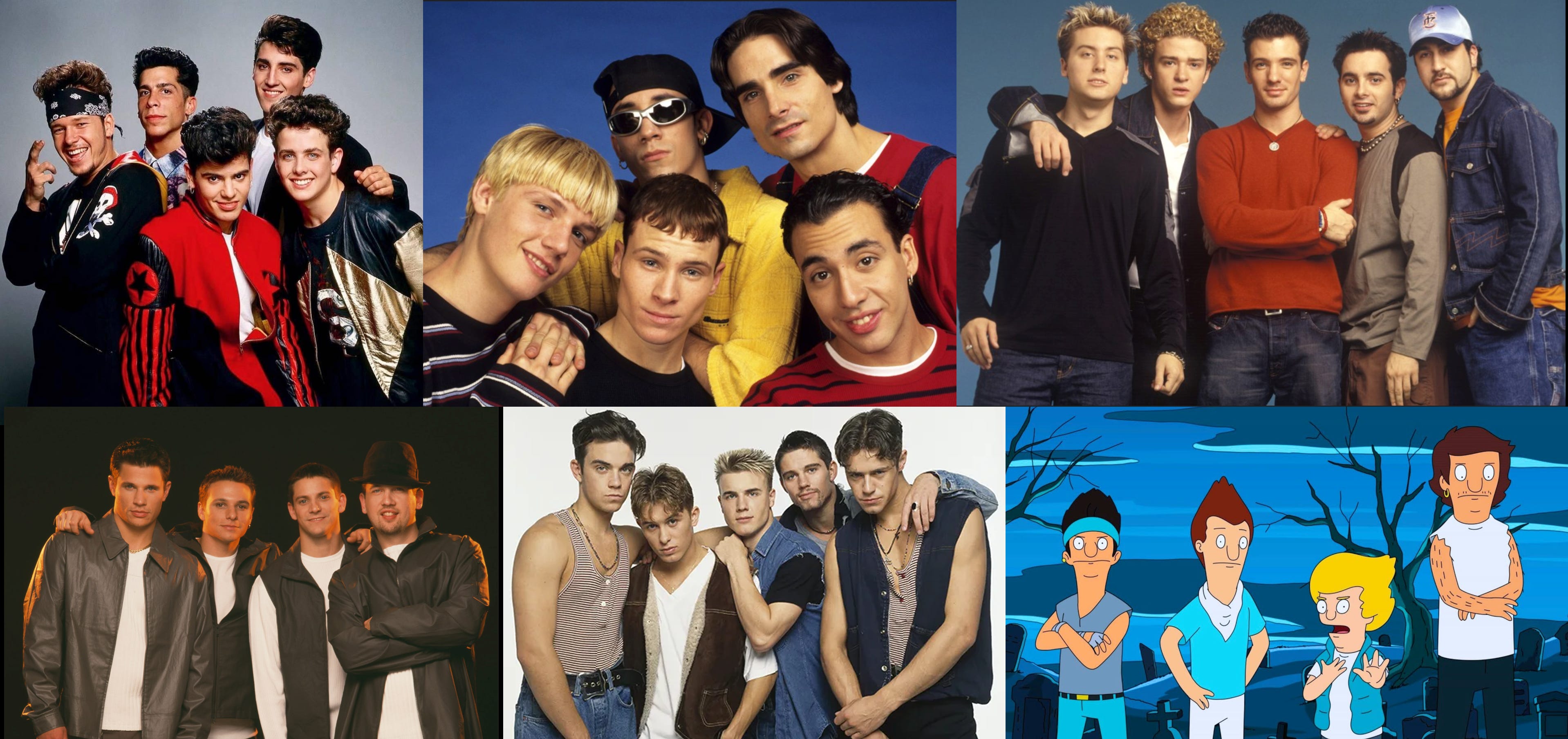
Boy bands are, you might argue, a bit of an unfair metric for popular culture more broadly, as they represent a particularly manufactured form of anodyne pop music.9 And, well, yes—that’s sort of the point, insofar as they make explicit the tendencies Adorno and Horkheimer outline. There are, naturally, counterarguments—examples of exceptions that both prove the rule, and exceptions demonstrate genuine resistance to the levelling effects of the culture industry.10 Overall, however, the basic thesis is difficult to rebut, especially as the culture industry has grown by a magnitude and corporate juggernauts like Disney and Amazon assimilate more of what we watch, read, and listen to like insatiable Borg cubes.
All of which is by way of returning to my earlier question about just how substantive these many paradigm shifts have been, when the economic imperatives underwriting mass cultural production don’t change, and the modes of cultural production don’t get upended. Considering that Adorno and Horkheimer first articulated their culture industry thesis in 1947, it has proven remarkably durable through the myriad media transformations of the late 20th and early 21st centuries. There’s a reason it’s a reliable staple on popular culture courses like mine.
III. That being said, if I’m doing a deeper dive in advance of my pop culture classes this coming year, it’s because it does feel like things have been upended in some significant ways.
I don’t mean with regards to AI, though I also don’t not mean AI; if anything, AI just represents a further, and so far the greatest, amplification of the broader trends of social media and streaming. Three years ago, when I picked up the pop culture course again after not having taught it since 2017, I realized one of the key things I had to decide was: which streaming services would I oblige my students to subscribe to? That was, after all, the most straightforward way to access a critical mass of potential course content. Past strategies for guaranteeing access to multimedia material—most commonly, making sure it was available for viewing/listening at the university library—felt positively quaint in a brave new world in which students most commonly consume media on their phones, tablets, and laptops.
It is in part this shift in the hardware of media consumption that signals a sea change that is more than superficial. On one hand, screens have dominated popular culture since the advent of cinema; to make a terribly disingenuous argument, the difference between IMAX and your smartphone is just a difference in degree. But of course, we know that’s a disingenuous argument, not least because the IMAX screen isn’t portable and makes us subject to the whims of somebody else’s programming. The portability of our media hardware parallels the rise of streaming’s everything-everywhere, always at your fingertips, personally tailored programming on demand. The knock-on effects of the proliferation of both available content and the means by which to personalize consumption—untethered from any need for sociality—fundamentally changes the ground on which a course on popular culture rests.
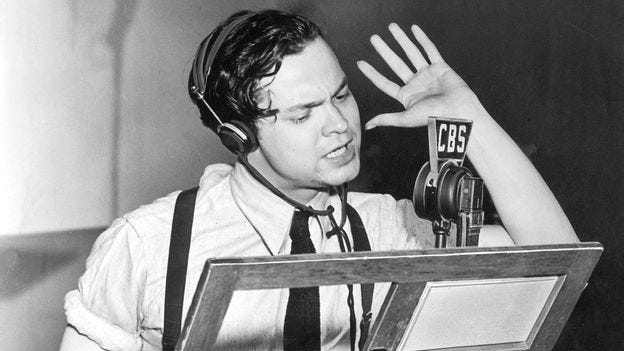
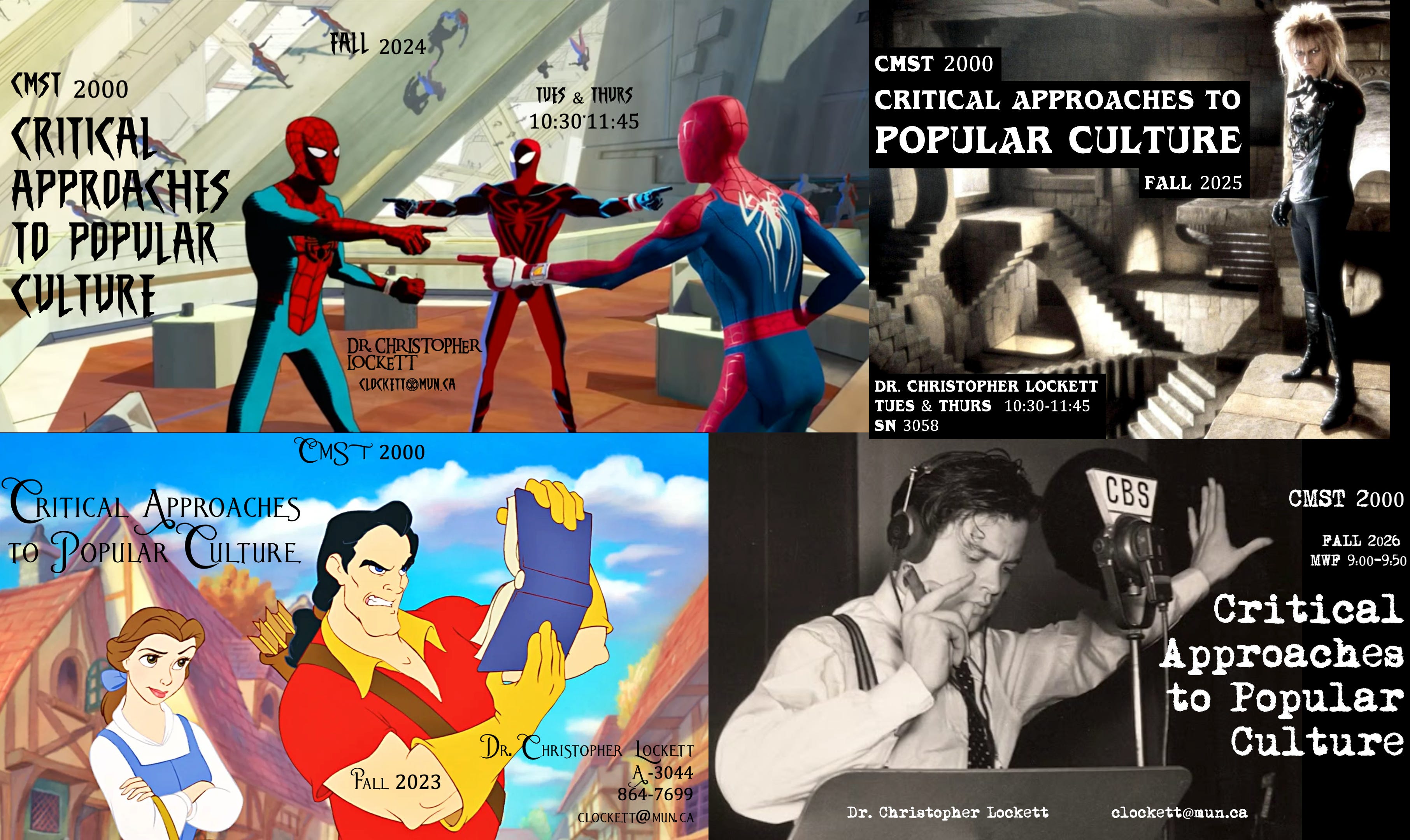
Which isn’t to say that Adorno and Horkheimer’s culture industry thesis is no longer applicable—to the contrary, it’s more relevant than ever. Ditto for other foundational theoretical texts of the study of popular and mass culture, from Walter Benjamin through Marshall McLuhan (all of whom with get a thorough airing in my class). But it has been becoming increasingly clear that the framework on which I’ve built my previous classes needs some renovation. One of the big ones will be to focus more specifically on the hardware of mass culture: from radio to the television set and cinema screen to smart phones. Hence why my course poster features Orson Welles: the very first thing we’re going to be doing is the 1938 Mercury Theatre production of War of the Worlds, which notoriously sparked a panic among listeners who believed an actual Martian invasion was under way.
The course is still being constructed. But as I said at the start of my most recent post, one way I mean to continue being productive here at The Magical Humanist while also teaching a full course load is to post about what I’m teaching and sharing my lectures, er, thoughts in this space as I go.
So: more to come!
My wife and I frequently have occasion to observe that our cats are SUCH weird little guys. Case in point is Gloucester here in a fairly typical resting pose on the new couch.

NOTES
Unless the unlikely happens and the university greenlights enough new hires to provide CMST with enough full-time faculty to properly administer the program. Our present complement of 2.5 full-time profs (the person comprising the one-half of that sum divides his duties between Communications Studies and Creative Writing) is frankly insufficient for one of our few growing programs. Me teaching one of the required courses offers a small amount of relief to our otherwise overburdened CMST people. To that end, it was our outgoing department head who told me that, again barring the possibility of a bunch of new hires, I can look forward to teaching the course for the foreseeable future. To which I say: sure, threaten me with a good time.
TL;DR: the song seems at first glance to be a working-class anthem in the vein of fellow New Jerseyite Bruce Springsteen. Tommy, blue-collar union man and stevedore, is currently out of work because of labour unrest; things are dire enough that he’s had to pawn his guitar. Gina, his girlfriend, works a shitty diner job that, presumably, must provide for them both. Released in 1986, the song—again, in line with the Boss—seems a cri de coeur against the Reagan/Thatcher anti-labour, pro-Wall Street culture of elite greed. BUT. The song is no “Ghost of Tom Joad.” Instead of providing a rallying cry for the put-down blue collar man and woman, it instead exhorts the listener to believe that things will work out. How? Well, apparently, we can live on a prayer … something that echoes Reagan’s pious religiosity, offered as a salve for the struggling poor, while the wealthy had to make do with tax cuts and financial deregulation (and cocaine).
Since then rebranded as “Western University,” nomenclature I resolutely reject. “Western Ontario” is already geographically misleading, which is evident for anybody who’s looked at a map of Canada. Simply calling it “Western” is, at best, even more geographically inane; at worst, it’s a paean to “western civilization,” which doesn’t really put it in good company these days.
Full disclosure: I honestly don’t remember how the conversation went at that gathering. It’s possible I made some of my most salient points to my new philosopher friend; it’s equally possible I made some quip and changed the topic but then went on to have the conversation in my head in the days that followed. As it became a point of introduction in my classes, the story has of course gotten embroidered and fleshed out. One way or another, the main framework I establish for my students is germane no matter what the substance of that conversation twenty years ago was.
Depending on which source your consult, the gaming industry grosses from $200B-$250B annually, more than the music and film industries combined.
Yet another example of how the entertainment industry is leery of novelty and will almost always embrace familiar and well-established intellectual property rather than untried experiments, even when the very medium itself is radically new.
To be sure, some of the most popular and trusted figures on television, like Ed Sullivan and Walter Cronkite, weren’t winning beauty pageants, and today might find studio executives looking at them askance and passing them over for someone more obviously from central casting. On the other hand, as has been argued at length, it’s likely that John F. Kennedy’s telegenic good looks put him over the top in the first American election to play out on the television screen—though even then, it was one of the closest decisions in U.S. history.
The much-anthologized essay “The Culture Industry” was a long chapter in their book Dialectic of Enlightenment, first published in German in 1947. Their overarching argument was that the rationalism of the Enlightenment, when taken to its extreme, produced the irrationality of fascism and Nazism—instrumental reason that ends up serving as justification for and the principal tool of totalitarian barbarism. Adorno and Horkheimer, both German Jewish intellectuals, fled Germany in the early days of the Third Reich and ended up living and working in the United States. Though the U.S. was preferable to the regime they’d escaped, they were dismayed by an American culture whose wholesale subordination to capitalism reproduced an ironic mirror image of totalitarian logic in which American mass culture narrowed the possible avenues of expression not by state censorship, but by the transformation of art to a consumer commodity that lacked the potential for genuinely revolutionary capacity.
My little collage of boy bands barely scrapes the surface of the vast number of boy bands. I left off examples from the recent surge of Korean supergroups like BTS, in part because I choose discretion over valour rather than risk the ire of that particularly rabid fan base. I left off One Direction for similar reasons, as including them in this lecture several years ago provoked a response from the Harry Styles devotees in my class that made me fear for my person. You will also possibly note that my choices here are notably monochromatic, in spite of the fact that there’s comparably huge number of Black boy bands (Boyz II Men, for example, or B2K). The reason for this elision is twofold: one, there’s a more complex history there rooted in the lineage of R&B and early rock and roll, which spawned a host of singing groups like The Temptations and The Four Tops (not technically boy bands, obviously, but providing a template); the Jackson Five weren’t the first boy band per se, but they comprise an early exemplar. This musical history is partly a history of exploitation and appropriation by white music labels, which made money off Black acts while also creating derivative white imitations. Which is reason number two for my monochromatic choices: these acts are the purest distillation of corporate music creation, manufactured specifically to be sexually unthreatening and hence acceptable to (white) parents of the (white) tween and teen girl demographic for whom they’re assembled. (The fact that there are some genuine bangers in their collective songbook is a testament to human creativity, even if the best of their songs still remain, per Adorno and Horkheimer, entirely interchangeable. “Everybody (Backstreet’s Back)” is in fairly frequent and unapologetic rotation on my running playlists.)
My go-to example of the latter these days is Andor, the Star Wars prequel-to-a-prequel, which, when I first saw advertised, I heaved a sigh and thought “Not more Star Wars franchise slop.” As I’ve written about here previously, Disney is determined to squeeze every last dollar from the exhausted wet flannel of its various acquisitions, from Marvel on down. After The Book of Boba Fett and Obi-Wan Kenobi, I was pretty much done. But then … Andor. The exception that proves the rule.
Burying Bon Jovi gold in a footnote? May I submit my vote for fuller treatment one day?