
Hyperbolic Worlds
Thinking at scale

pity this busy monster, manunkind,
not. Progress is a comfortable disease:
your victim (death and life safely beyond)
plays with the bigness of his littleness
—e.e. cummings
I. Between an infinity of possible worlds in the multiverse, the dream of galactic empires comprising thousands of planets, and the unthinkable resources needed to power interstellar travel, it would seem my theme for the past month and a half or so has been one of excess and hyperbole in the SF imagination. My mind is still there: I want to noodle about in that space1 awhile longer in this essay. I’m thinking now of what I like to call “hyperbolic worlds,” which I use to mean, variously, megastructures like the Dyson Sphere or the Ringworld of Larry Niven’s Ringworld, or else planets that have been reengineered—terraformed, transformed into massive spacecraft, or, as in Philip José Farmer’s Riverworld series, landscaped into a ten million mile long river valley (for reasons).
I started thinking about this topic again, which is something I’ve pondered since first reading Ringworld (1970), after quoting, in my post-before-last, from the section in The Hitchhiker’s Guide to the Galaxy that describes the ultimate decadent industry catering to the hyper-wealthy: “custom-made, luxury planet-building” (89). When Arthur Dent, in his picaresque, stumbling travels, finds his way to the planet Magrathea, he is taken by a man with the unfortunate name Slartibartfast into the planet to see the “factory floor.” Slartibartfast warns Arthur, “the chamber we are about to pass into does not literally exist within our planet. It is a little too … large. We are about to pass through a gateway into a vast tract of hyperspace” (121). The description Douglas Adams offers of the space into which they emerge is a useful starting point. Though Arthur suddenly gets “a fairly clear idea of what infinity looked like,”
It wasn’t infinity in fact. Infinity itself looks flat and uninteresting. Looking up into the night sky is looking into infinity—distance is incomprehensible and therefore meaningless. The chamber into which the aircar emerged was anything but infinite. It was just very very very big, so big that it gave the impression of infinity far better than infinity itself.
We literally cannot think the infinite—as my favourite math teacher in high school always emphasized, infinity is not merely a very large number but is something else entirely. In our blinkered way, however, we gesture at it precisely by thinking in terms of “very very very big” things: the Grand Canyon, for example, or imagined megastructures, and we ascribe godlike abilities to those who build or create such things.
This last element is an interestingly recurrent tendency in SF—interesting in part because, though SF on balance bends toward a markedly secular worldview,2 our stubborn predisposition to imagine gods and godlike beings persists when the scale of fictional ideation approaches (to use Adams’s phrasing) “the impression of infinity.” We might indeed tweak Arthur C. Clarke’s infamous dictum that “a sufficiently advanced technology will appear as magic” to note that, similarly, a sufficiently advanced alien species will appear godlike … or at least leave behind artifacts that the human imagination cannot help but attribute to gods. It’s a common enough trope that a representative list of examples only scratches the surface: the Progenitors of Star Trek, the Shadows and Vorlons of Babylon 5, the Old Ones of H.P. Lovecraft’s legendarium, the mysterious creators of the protomolecule in The Expanse, the Overlords of Arthur C. Clarke’s Childhood’s End (1953), the various tiers of gods in the MCU (Asgardians, Celestials, Galactus); and, as I’ll discuss further below, the Puppeteers and Pak Protectors of Niven’s Ringworld books and the “Ethicals” of Farmer’s Riverworld series.
I could go on. But the point is that there seems to be an inescapable element of the human imagination that yearns toward a sense of higher power, be that in the form of gods or God or the Universe itself—or humanity in a later stages of technological evolution.
II. I was first turned onto Philip José Farmer’s Riverworld books when reading Postmodernist Fiction (1987) by Brian McHale as an undergrad. He mentions them in the broader contexts of SF’s analogues and overlaps with postmodernist fiction; the four-novel series3 takes place on an Earth-like planet (which could possibly be Earth) that has been terraformed into a single river valley ten million miles long winding like a classical unicursal labyrinth across the entirety of the planet’s surface. Along this river, the entirety of humanity that has ever lived, from the first homo sapiens up to a point early in the twenty-first century—some thirty-six billion people—finds itself resurrected. How did this happen? Who orchestrated this? And perhaps most importantly, why?
Intrigued by the premise, I went searching for the books, only to discover they were then out of print. I finally scavenged the first two at a second-hand bookstore and found the latter two in the university library. Serendipitously, in that same used bookstore I stumbled across Larry Niven’s Ringworld (1970), a novel I’d read about but never found among the shiny new paperbacks of regular bookstores.4 So it was that in reading Farmer and Niven closely upon each other and McHale’s theoretical framework in my mind that I first hit on the idea about writing something with regard to “hyperbolic worlds.”
That was nigh on thirty years ago. Some ideas, it seems, braise for longer than others.
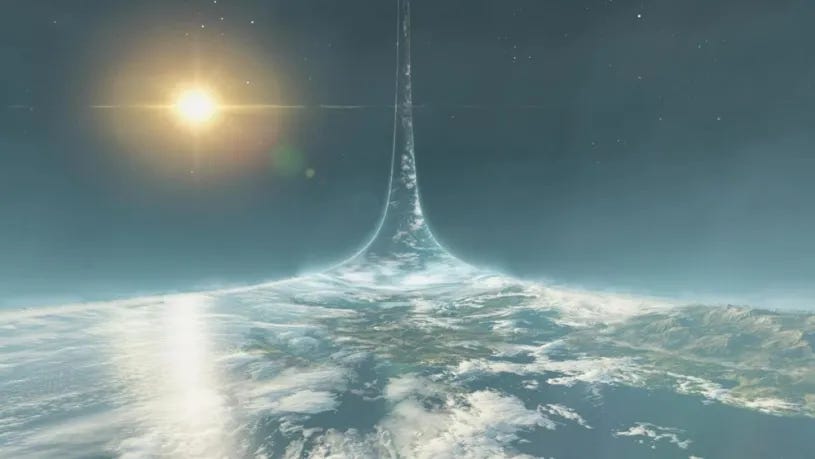
Farmer and Niven imagine different hyperboles: the former a world reshaped, the latter a megastructure that seems to be an artifact of a now-vanished hyper-advanced alien civilization. The Ringworld—whose familiar but diminished form I encountered on first playing Halo—is a ribbon one million miles wide and whose circumference is approximately the same as the Earth’s orbit. Its surface is habitable, featuring plains and forests, mountains and rivers and seas, all presumably as artificially engineered as the ring itself, which is built of an unknown high-tensile material.
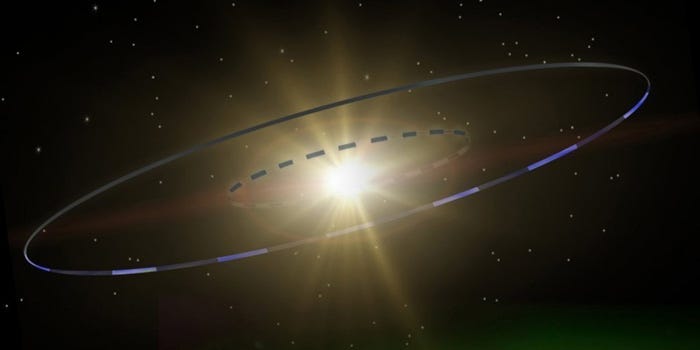
This implications of this startling structure terrify an advanced alien race known as the Pierson’s Puppeteers. Given that the overriding trait of this species is an overabundance of caution, they hire the human Louis Wu to investigate. Who built it? And how?
The question of why, by contrast, is easy to discern. When one of Louis’s companions asks, he offers the most obvious answer.
Teela’s eyes had been turned to the ceiling, and her lips had been moving silently but rapidly. “He’s right,” she said. “The math works out. But what’s it for? Why would anyone build such a thing?”
“Room.”
“Room?”
“Room to live,” Louis amplified. “That’s what it’s all about. Six hundred trillion square miles of surface area is three million times the surface area of the Earth. It’d be like having three million worlds all mapped flat and joined edge to edge. Three million miles within aircar distance. That’d solve any population problem.” (80-81)
Larry Niven has said he conceived of the Ringworld as a compromise on the Dyson Sphere, a megastructure that wouldn’t ring a star so much as enclose it entirely. Physicist Freeman Dyson proposed the idea in a 1960 article in Science magazine as a means by which hyper-advanced alien civilizations could harness something approaching the totality of a star’s radiant energy.5 The principal disconnect between Dyson’s proposal and Niven’s compromise is the purpose imagined: Louis Wu sees the Ringworld as a solution to overpopulation, while Dyson’s sphere addresses a need for energy. Though it has been adopted in SF as a rigid sphere with a habitable surface,6 Dyson imagined it comprised of a swarm of satellites.
Dyson credited his conception to the pioneering English SF author Olaf Stapledon’s novel Star Maker (1937). Though he modestly suggested a more deserved name would be “Stapledon Sphere,” the description in the novel is blink-and-miss-it, a passing reference to stars “surrounded by a gauze of light traps, which focused the escaping solar energy for intelligent use” (380). I’d say Dyson’s extrapolation earns him naming rights, though that’s a little bit beside the point here. The broader significance of Stapledon’s work in this context is that the scale of the Dyson Sphere—itself a magnitude larger than the Ringworld, which in its own turn is a more hyperbolically imagined megastructure than Farmer’s Riverworld—is miniscule in the galaxy-spanning journey of Stapledon’s narrator.
Reading Stapledon’s fiction is a bit of a trip. Star Maker is often paired with his earlier novel Last and First Men (1931),7 which reads less as a novel than a chronological history of an imagined future. Last and First Men chronicles human evolution projected over two billion years. Not to be outdone in scope, Star Maker follows the saga of an Englishman whose consciousness, for reasons and by means that remain unexplained, is transported away from his body. Suddenly able to explore outer space, he travels to the stars and encounters other disembodied consciousnesses, with whom he merges. The ever-growing collective explores different planets and recounts their alien inhabitants and civilizations, moving on to stars and sentient galaxy-birthing nebulae, and, ultimately, the understanding that this universe is just one reality in an infinite multiverse.8
I highlight Stapledon’s work and his influence on subsequent SF in part because he exemplifies the tendency I’ve been exploring in my most recent essays—the tendency to think on grand scale, and the overlap between certain strains of SF with mythology and indeed mysticism. Though it tends to be understood as the more rational and secular genre in contrast to fantasy’s origins in romance and religion, SF frequently displays a similar propensity for finding mystery and transcendence in the unthinkable scale of the universe.
III. I remember my first glimpse of the Grand Canyon as a moment in which I had a fleeting glimpse of what animates the thinking of young earth Creationists. Among their various torturous “proofs” of the literal truth of Genesis, the Grand Canyon often features prominently as evidence of the Great Flood. What other force but the sheer power of God’s wrath visited on the world could have inflicted such a massive wound on the earth’s surface?
The vantage from where I first looked down into the Grand Canyon and then into its depths running away into the distance was at a lookout behind a low wall, set in the midst of a cluster of gift shops and interpretation centres, a village of touristy buildings immediately adjacent to the parking lot where I’d parked the rental car. What might in other contexts have felt like a kitschy pimple on a natural wonder faded to nothing in contrast to the view I was afforded: one of those awe-inspiring intrusions of the natural world, like a vast mountain or a tempestuous sea, that defies the human capacity to reduce or domesticate or otherwise overmatch it with our own manufactured monuments. It was a sublime experience in the true sense of the term, beautiful and terrifying, the latter not least because it was utterly indifferent to my puny human existence. I didn’t need to read the ubiquitous signs warning about the dangers of hiking too far into the canyon without proper supplies and an appropriate level of physical fitness—it was obvious at first glance it could consume me and not notice.

A much younger version of myself would have probably seen the hand of God at work. That the version of myself present in that moment saw millions of years of erosion and could read the aeons in the sedimentary layers did not denude the sublimity of the experience. Quite the opposite: the sensation of the vastness of time, looking down into what is essentially the river valley to end all river valleys, was palpable. I grasped the sort of confirmation bias the Grand Canyon offers its beholder, especially at first glance. Those inclined to see the Earth’s antiquity will feel the millions and billions of years embedded in the rock and stone. Those convinced of the literal truth of scripture will see the deep chasm as carved by the force of the Flood, within which one also discerns the infinite precision of God’s design, where no molecule of erosion is accidental.
These are two opposing conceptions of the infinite: the unthinkable vastness of the universe on one hand, an all-encompassing deity on the other. There is, to be certain, an enormous amount of real estate between an atheist’s awe at the universe and a personal God whose infinitude is, paradoxically, strictly circumscribed by Scripture; this spiritual spectrum covers an immeasurable range of belief. It took the Grand Canyon to give me a flash of empathy and even sympathy for the fundamentalist extreme. I had that moment, standing there at the lip of mind-numbing enormity, but only a moment. I snapped back to myself quickly enough, to my general sense of fundamentalism’s imaginative impoverishment—of its need to see the eternities of space and time contained in the claustrophobic confines of six millennia and needing to invent a conspiracy of scientists from Darwin onward who fabricate evidence of evolution and a planet of much longer vintage that a literal reading of the Bible provides. The elaborate complexities of such a supposition make the Big Bang seem almost banal in its simplicity.
IV. There is however a shared desire rooted in both extremes, as expressed in our more hyperbolic fictions. The earliest myths from across cultures, perhaps unsurprisingly, are usually preoccupied with the world’s creation. The earliest and most rudimentary iterations of such stories frequently take for their main characters the enormities of sky and earth, the heavens and underworlds, stars, oceans, mountains … often in a confusion of hard-to-picture, incestuous copulations and subsequent births, followed by yet more cosmic incest birthing a greater proliferation of aetiological gods. Earth and sky or sky and sea knock boots, as do night and darkness, giving birth, variously, to dream and eros and the sun, and so on. (I’m not being specific here to any one mythic tradition but am travestying the finer distinctions made by the Greeks or Egyptians or Mesopotamians, among many other pantheons). The Judeo-Christian creation story is an outlier for how staid it is, depicting an OCD Supreme Being who ticks items off his to-do list with admirable dispatch and makes a point of leaving a day for self-care.
Whatever sense of enormity is lost in Genesis, John Milton reinstates in Paradise Lost: he describes the sphere of our known universe as tiny and barely visible in the midst of the infinitude of Chaos.9 As Satan makes his long journey from Hell to make mischief with God’s new pet project, he sees our world hanging from Heaven by a golden chain:
That Satan with less toil, and now with ease
Wafts on the calmer wave by dubious light
And like a weather-beaten Vessel holds
Gladly the Port, though Shrouds and Tackle torn;
Or in the emptier waste, resembling Air,
Weighs his spread wings, at leisure to behold
Farr off th’ Empyreal Heav’n, extended wide
In circuit, undetermined square or round,
With Opal Towrs and Battlements adorn’d
Of living Saphire, once his native Seat;
And fast by hanging in a golden Chain
This pendant world, in bigness as a Star
Of smallest Magnitude close by the Moon.
Thither full fraught with mischievous revenge,
Accurst, and in a cursed hour he hies. (II.1041-1055)
I had the great good fortune in the first year of my PhD to work as a teaching assistant for John Leonard, one of the world’s leading Milton scholars. In our first-year English survey, he made a point of emphasizing the scale of Milton’s universe, which dwarfs our world to an infinitesimal pinprick in the cosmos.10 On the blackboard he drew a rough approximation, with Heaven occupying the top, Hell the bottom, and Chaos in between. Our world—which is to say, our universe, which includes the sun, moon, and planets, and is bounded by the outer sphere of the stars—is a “pendant world,” hanging from Heaven by a chain, miniscule relative to the vastness surrounding it.
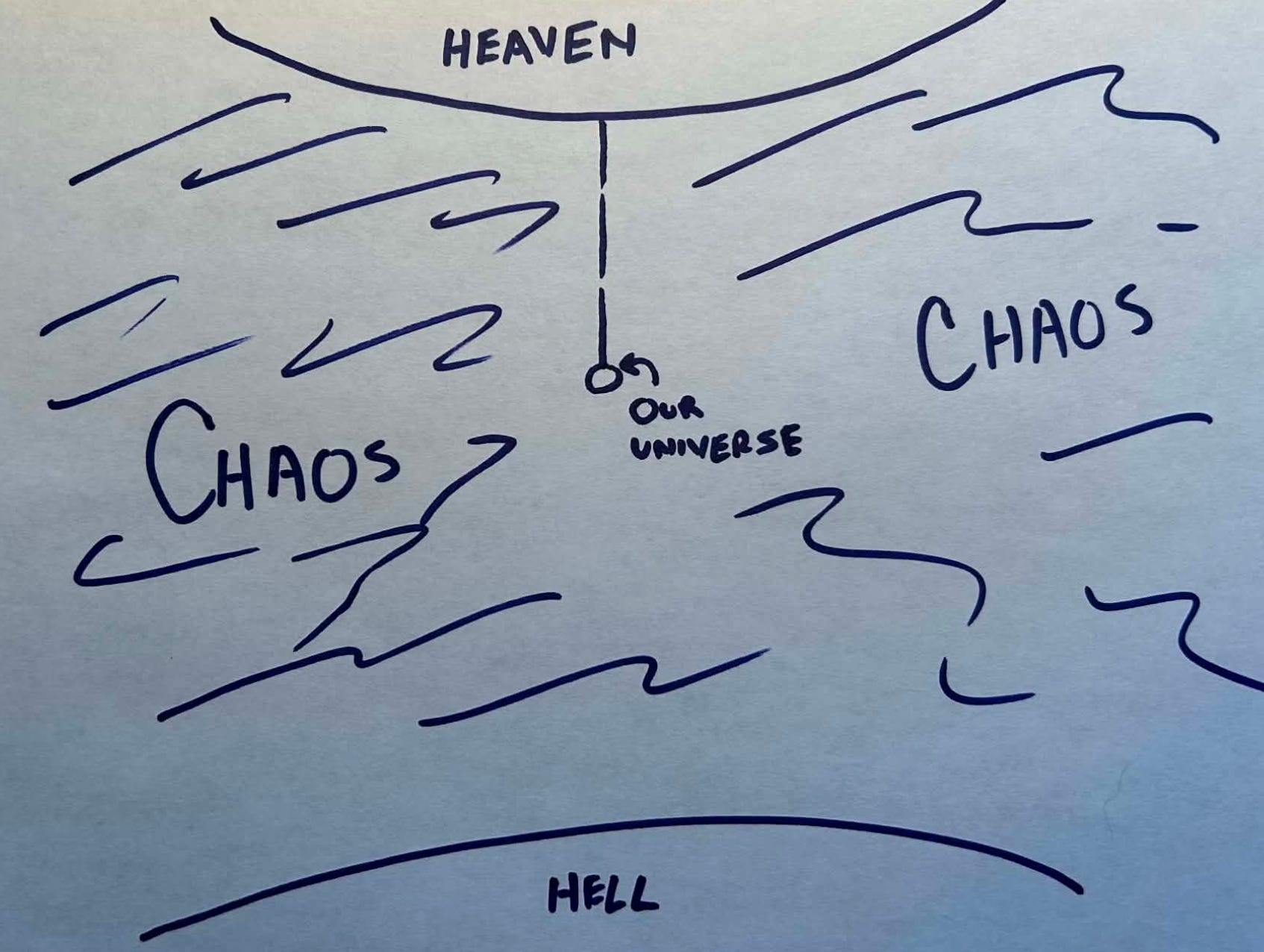
Pointing to the sketch of Milton’s cosmos, John observed that an argument could be made that Paradise Lost can be seen as an early precursor to SF, insofar as it features a rare depiction of interstellar travel within a universe much vaster than had been conventional to that point. With a handful of exceptions—some of which I’ll talk about momentarily—the model of the cosmos inherited from Aristotle and Ptolemy was very specifically finite. The medieval Christian universe adopted this finitude; as Arthur Koestler asserts in The Sleepwalkers, his history of the Copernican Revolution, “The medieval Christian universe had hard, firm limits in space, time, and knowledge” (219). The world was created somewhere around 4000 BC, and would end in the possibly foreseeable future; in space, “the world was equally bounded by the ninth sphere, beyond which lay the heavenly Empyrean”; and finally there were “equally firm limits to the progress of knowledge,” all of which had been settled—religion by Scripture, geometry by Euclid, and physics by Aristotle. “The science of the ancients was taken as Gospel truth,” Koestler writes, “not because of any particular respect for the pagan Greeks, but because it was obvious that since they had come so much earlier they had harvested all there was to harvest.” The authority of the ancients rested “on the belief in the finite nature of knowledge.”
There had been a moment in Ancient Greece, Koestler notes, in which the sun-centred universe was proposed by a handful of philosophers and astronomers, most notably by Aristarchus of Samos. More significantly, Aristarchus made the more dramatic suggestion that, not only did the Earth orbit the sun, but that our sun was just one of countless stars in a potentially infinite cosmos. Unfortunately for the next millennium and a half or so of astronomy, Aristarchus’s theory was overruled by a scholar who went on to dominate western thought. Though “The Ionians had prised the world-oyster open, the Pythagoreans had set the earth-ball adrift in it, the Atomists dissolved its boundaries in the infinite,” Koestler writes, “Aristotle closed the lid again with a bang, shoved the earth back into the world’s center, and deprived it of motion” (61).
When looking back over the history of heliocentric versus geocentric conceptions of the universe, it’s important to keep in mind that the simple shift of the relative positions of earth and sun is far less radical than the conception of infinite space. Copernicus might have initiated a revolution, properly speaking,11 but he did so as modestly as he could manage, including a preface with the caveat that this sun-centred model was just a model for the purposes of more accurate astronomical prediction. But aside from the swapping of sun and earth, he hewed to the precepts of the Ptolemaic system, with its perfect circles, epicycles, and the ultimate boundary of the ninth sphere of the stars. And though the swap was meant as an elegant solution to the problem of the planets’ eccentric orbits and retrograde movement,12 what Copernicus produced was actually less accurate than the Ptolemaic tables.
Of course, once you move the Earth from the centre of everything, you’re upending a cosmology grounded in both the presumption of centrality to everything but also the understanding of the Earth as fallen and impure in comparison to the perfection of the heavenly spheres. The term “sublunary,” such as it appears in the poetry of John Donne13 refers to the gross and mortal. We are beneath the realm of the divine, and beneath us, in the medieval geography informing Dante’s Inferno, is Hell. The turfing of the Earth to the third orbit dislocates premises for both exceptionalism and original sin.
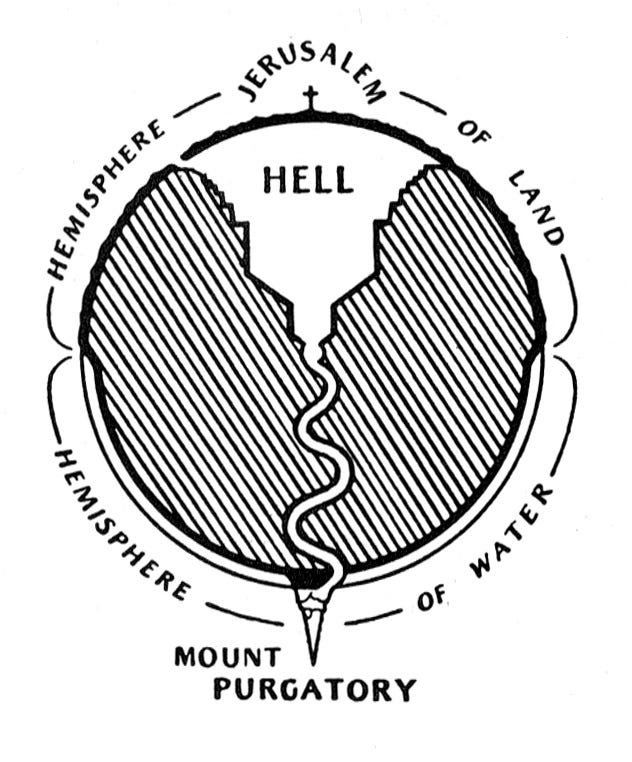
V. In one medieval model of the world, Hell was physically formed by Lucifer’s Fall. When he and his rebel angels were cast out of Heaven, they struck the world with such force that they punched a hole that caused a mountain to erupt at its antipode. The crater became the abode of Satan and his minions, and the mountain Purgatory. A little over three centuries later,14 Milton removed Hell from Earth and placed it outside our “pendant world” at the “bottom”15 of the gulf of Chaos; Hell in Milton’s telling is an unthinkably huge piece of real estate, but its vast diabolical geography finds itself dwarfed by an even vaster cosmos.
Milton’s remapping of the finite medieval universe to one that is potentially infinite—and what’s more, contains not just the infinity of God, but of Chaos—is as perfect an exemplar of the paradigm shift from the medieval to modern conception of the universe as you’re likely to find.
Or possibly not. On Sunday mornings I go to the gym with a good friend of mine who is a medievalist in our department; our conversations as we lift weights16 are always wide-ranging, enjoyable, and educational. And I’ve learned to temper my tendency to think in reductive medieval versus modern historical paradigms. In the early stages of starting to draft this essay, when it occurred to me to use Arthur Koestler’s assertion about the Christian medieval universe as having “hard, firm limits in space, time, and knowledge,” I thought it was probably wise to run it by my friend. When I read The Sleepwalkers for the first time in my early 20s, it was one of those life-and-mind-changing books for me. His characterization of the finite medieval universe sank deep. Thirty years later, however, it felt a bit reductive. When I quoted the passage to my friend, his face assumed the pained expression with which I’ve become familiar, whenever anybody (usually me) says something obtuse about the Middle Ages. “While that’s technically true,” he said diplomatically, “you’re right in thinking it’s reductive.” The medieval Christian universe was finite, but the way Koestler frames it—especially with regards to knowledge—is redolent of a larger tendency to think of medieval society as intellectually stunted and immature, which ignores the extraordinarily rich imaginative and intellectual life of the era.
A useful riposte to Koestler can be found with none other than C.S. Lewis, who effectively argued in The Discarded Image (1964) that the distinction between medieval finitude and the expansiveness of the modern universe is little better than a canard. He makes his case in a passage worth quoting in full, both for its substance and its lyricism:
You must go out on a starry night and walk about for half an hour trying to see the sky in terms of the old cosmology. Remember that you now have an absolute Up and Down. The Earth is really the centre, really the lowest place; movement to it from whatever direction is downward movement. As a modern, you located the stars at a great distance. For distance you must now substitute that very special, and far less abstract, sort of distance which we call height; height, which speaks immediately to our muscles and nerves. The Medieval Model is vertiginous. And the fact that the height of the stars in the medieval astronomy is very small compared with their distance in the modern, will turn out not to have the kind of importance you anticipated. For thought and imagination, ten million miles and a thousand million are much the same. Both can be conceived (that is, we can do sums with both) and neither can be imagined; and the more imagination we have the better we shall know this. The really important difference is that the medieval universe, unimaginably large, was also unambiguously finite. And one unexpected result of this is to make the smallness of Earth more vividly felt (98-99).
Lewis’s argument here, that an “unambiguously finite” universe serves to make clear the smallness of our world more effectively than can the unthinkable infinite, is of a piece with Douglas Adams’s observation that something immense but finite “[gives] the impression of infinity far better than infinity itself.” Hyperbolic worlds and the megastructures of the SF imagination are a gesture at a sort of manufactured sublime in this vein, at once allegorical and metonymic, objects that stand in for an infinitude from which the human mind instinctively shrinks while simultaneously desiring to know.
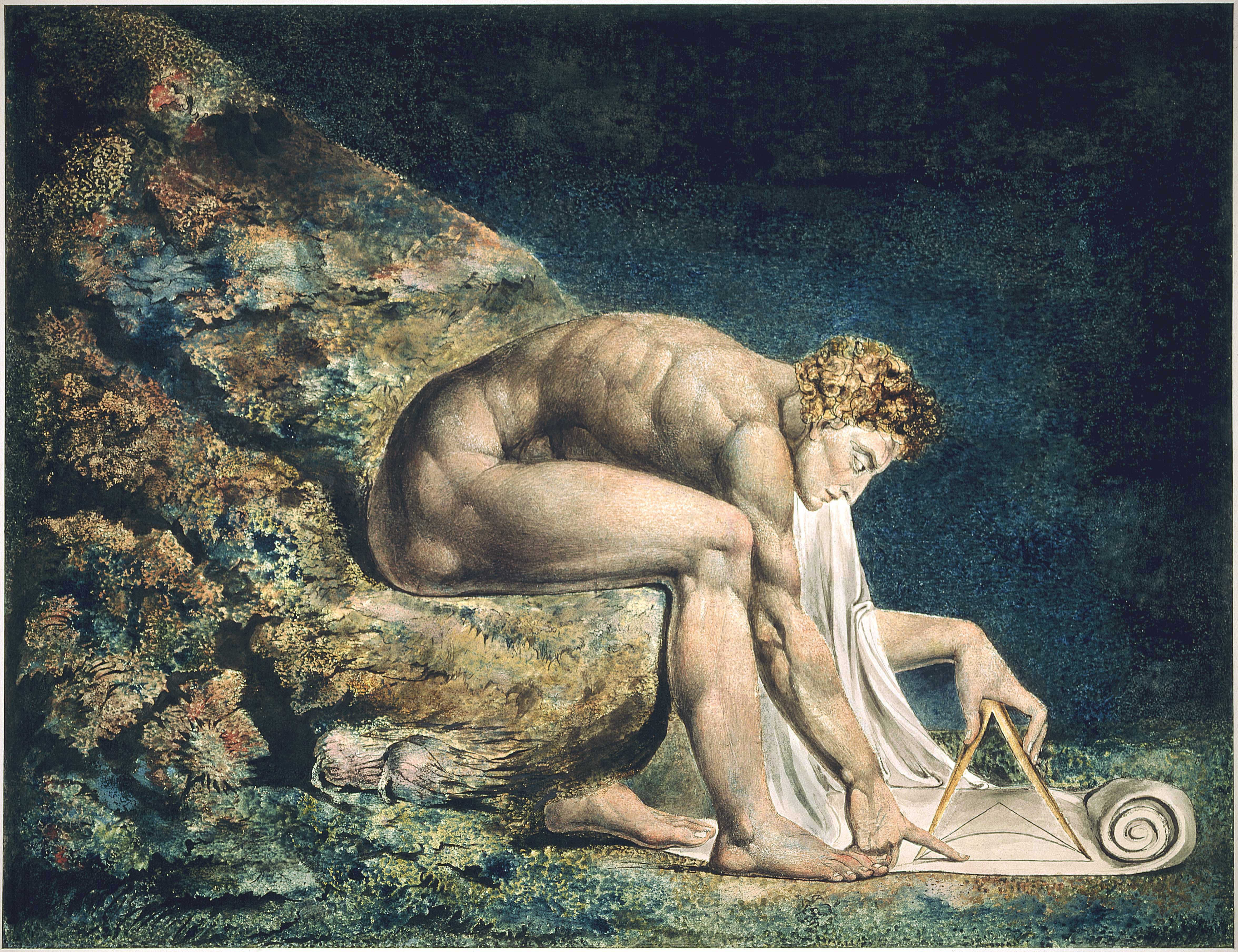
Lewis didn’t see in the edifices of modern science anything resembling the expansiveness he attributed to medieval thought. The discoveries and innovations that revealed the heavens expanded the universe spatially while simultaneously serving to reduce it to the purely quantifiable. “On the imaginative and emotional level,” he writes, “it makes a great difference whether, with the medievals, we project upon the universe our strivings and desires, or with the moderns, our police-system and our traffic regulations” (94). We hear here an echo of Romantic sentiment, perhaps, of Wordsworth’s admonition that “We murder to dissect” or Keats’s charge that science sought to “unweave the rainbow.”17 Or William Blake’s painting depicting Isaac Newton as a stunted, cramped pedant futzing about with a compass and paper with his back turned to the wonders of the world.
Like his good friend J.R.R. Tolkien, Lewis spent the balance of his scholarly and creative life working toward a restoration of a medieval sensibility. In this respect he can be called antimodern, as he saw in modernity an arid positivism that voided the spiritual. His antipathy to modernist literature—T.S. Eliot was the bête noire for him and Tolkien and their Oxford circle—is perhaps ironic, given that a critical mass of modernists nurtured a similar disaffection with the historical moment. Though the experimentalism of the moderns offended Lewis et al’s sensibilities, works like The Waste Land (1922) exhibited its own search for a transcendence of modernity’s reductive rationality in its exploration of the Grail legend’s prehistory. So too the occultism of W.B. Yeats and Ezra Pound, or the delving into the internal infinitude of dreams by surrealism, or even Ernest Hemingway’s fascination with bullfighting, in which he saw vestiges of premodern mythic ritual.
VI. To be perfectly candid, this essay has been one of the most difficulty ones I’ve written here—and it has certainly gone on longer than I’d planned. So if you’re still with me, thanks for your patience. What started as a vague idea to write about hyperbolic worlds as a continuation of a thread started in my most recent essays has become something else. I haven’t stuck the landing here, but hopefully it’s been an interesting ride. As I wrote in my most recent post, writing can be like the path Bilbo describes passing by one’s door—you’re never entirely sure where it will take you.
So in lieu of a conclusion, I’ll say that this tension between the stultifying reductivity of instrumental reason and the human yearning for transcendence has hardly faded. In an algorithmically determined world in which our personal information is monetized and Oscar Wilde’s definition of cynicism as “knowing the price of everything and the value of nothing” has been elevated to the basis of our digital economy, the ideation of an expanded universe (to coin an expression) reflects the ever-present yearning for something beyond.
You’ve earned your cat picture, if you’ve read this far. So here’s Bartleby, apparently in close consultation with the jackalope I bought my wife when we were first dating, who now hangs out with the cats on the bed.

REFERENCES
Adams, Douglas. The Hitchhiker’s Guide to the Galaxy. Pan, 1979.
Koestler, Arthur. The Sleepwalkers: A History of Man’s Changing Vision of the Universe. Arkana (Penguin), 1989 (1959).
Lewis, C.S. The Discarded Image: An Introduction to Medieval and Renaissance Literature. Cambridge UP, 1964.
Stapledon, Olaf. Last and First Men & Star Maker. Dover, 1968.
NOTES
So to speak.
I’m speaking of course in very broad terms here. There are, obviously, numerous counterexamples of more religiously minded SF, just as (as I’ve written with regards to Terry Pratchett) there is an increasingly large amount of secular-minded fantasy in the present moment. This is not the space to hash out that particular discussion, so let’s not start enumerating the exceptions. I mean, unless you want to.
To Your Scattered Bodies Go (1971), The Fabulous Riverboat (1971), The Dark Design (1977), and The Magic Labyrinth (1980).
For all the conveniences of the online book market, I miss the scavenger hunts that occurred whenever I used to happen across used bookstores, which once upon a time punctuated the urban landscape like musty hoarders’ redoubts. I frequently kept a list of books in my wallet, unavailable for purchase otherwise, which would comprise my marching orders every time one of those unassuming stores hove into view.
Dyson conceived of his sphere as part of a discussion over how to find and identify advanced alien civilizations. He theorized that such civilizations would have enormous energy demands and could be recognized by the waste heat they generate. The Dyson Sphere, he proposed, would be a logical step in a spacefaring civilization’s evolution, a vastly more efficient means of harnessing a star’s energy.
Most famously in the Star Trek: The Next Generation episode “Relics” (season 6, episode 4) in which the Enterprise happens across an abandoned Dyson Sphere, whose provenance is never established. The episode is more memorable for the return of James Doohan as Mongomery “Scottie” Scott from the original series, whose ship is found crashed on the outside of the sphere with Scottie’s pattern saved in the ship’s transporter buffer. The sphere itself plays the role of a MacGuffin, never again to be referenced on the show (which is odd, considering it would be an object of concern). Freeman Dyson said he enjoyed the episode, but thought the science of it “nonsense,” as a rigid sphere around a star would be unstable.
Though he’s not as widely read in the present moment—and I will confess, I find his prose quite the slog, without much in the way of an engaging story on which to hang these future histories—it’s easy to see how his visions have been profoundly influential. He was lauded by such varied contemporaries as Algernon Blackwood, H.P. Lovecraft, and Jorge Luis Borges; Virginia Woolf, with whom Stapledon corresponded, was a fan; conversely, C.S. Lewis disliked what he considered the amorality of his fiction but did him the compliment of responding with his own SF novels as corrective. Arthur C. Clarke credited Stapledon as an early and elemental influence on his own game-changing SF.
I’m quite enjoying how these recent essays are all starting to overlap and show their thematic consonance in surprising ways.
Notably, Milton also reintroduces the sort of allegorical characters that populate the earliest creation myths: upon leaving Hell to seek out God’s new project (i.e. us), he encounters the figures of Sin and Death guarding the gates. Sin is depicted as being a beautiful woman from the waist up, but a monstrous and gross serpent below, whose bowels are constantly being consumed by hellish hounds. Sin was born, Athena-like, from Satan’s head the moment he determined to rebel against God. He promptly has sex with her, conceiving Death, who similarly pursues Sin and rapes her. From that union come the throng of hellhounds.
John would almost certainly chide me for using the word “cosmos” in this context, as cosmos means “order,” and Milton very specifically makes Chaos the largest piece of real estate in his universe.
I mean, it’s right there in the title of his book: De revolutionibus orbium coelestium, or, On the Revolutions of the Heavenly Spheres.
When you chart the course of, say, Mars across the night sky over several weeks, it seems to slow down, stop, and move backward for a spell before renewing its original path. This “retrograde movement” was attributed in the Ptolemaic system to “epicycles,” in which the planets weren’t in a fixed place on their respective spheres, but orbited a fixed point. What the Copernican shift recognized is that Earth and the planets all follow the same paths, but at different speeds over greater and lesser distances. Hence Mars seeming to slow, stop, and go backwards is an illusion caused by Earth overtaking Mars as they orbit the sun.
Specifically, in “A Valediction Forbidding Mourning” in which the speaker tells his romantic partner not to be sad in his absence, as they have a perfect, transcendent love. By contrast, others who conceive of love in purely physical and mortal terms, cannot bear to be parted: “Dull sublunary lovers’ love / (Whose soul is sense) cannot admit / Absence, because it doth remove / Those things which elemented it.” By contrast, the lovers of the poem “by a love so much refined” are “two souls therefore, which are one,” and thus can stand to be parted without any emotional sturm und drang.
In one of our alternate timelines in the multiverse in which I’m still a literature prof, I’m studying Renaissance and early modern literature and did my dissertation on how the Copernican Revolution appears (and doesn’t) in the literature of the period. On my more wistful days when I daydream about reinventing my personal wheel, this research project looms large.
Dante’s Divine Comedy first appeared in 1321; Paradise Lost’s first edition was published in 1667.
Allowing of course for the fact that such directional markers as “up” and “down” cease to have meaning when working at such an unthinkable scale.
This has been our custom for a couple of years now. After the first few of these Sunday sessions, when it was clear it was becoming a reliably regular thing, my wife quipped to me, “Wow, you guys are becoming gym bros.” To which I replied, “Correction: we’re gym bros with tenure.” She paused for a long moment before saying, “Please don’t start doing a podcast.”
Wordsworth’s line comes from his poem “The Tables Turned” in which he enjoins the reader to “quit your books” and go out to experience the joys of nature. Keats’s line is from his long poem “Lamia,” in which he writes that “Philosophy will clip an Angel’s wings, / Conquer all mysteries by rule and line, / Empty the haunted air, and gnomed mine— / Unweave a rainbow, as it erewhile made / The tender-person’d Lamia melt into a shade.”
"Things, in the words of G. K. Chesterton, were to grow incalculable by being calculated. Man’s powers were finite; the forces he had released in nature recognized no such limitations. They were the irrevocable monsters conjured up by a completely amateur sorcerer."
Loren Eiseley, The Star Thrower.
A quote from Chesterton, who, I think, would have (and probably did) find C.S. Lewis's efforts to re-enchant the world quite congenial. But Eiseley doesn't seek to flee the bleakness of the scientific worldview - he accepts it, saying that while there is no escaping the apparent insignificance of the scale at which human beings must dwell, human morality must be exercised in spite of this.
Would you include Gaea, the sentient world depicted by John Varley in his trilogy Titan, Wizard, and Demon? And if you haven't read those novels, please do so now. I'll wait. (I'll lend you my copies if nec.)